Advancing climate-resilient nutrition through integration: Insights from the 2026 Global Nutrition Report launch
Advancing climate-resilient nutrition through integration: Insights from the 2026 Global Nutrition Report launch
During Rome Nutrition Week, marking World Nutrition Day (28 May), the Global Nutrition Report (GNR) launched the 2026 Global Nutrition Report—the first thematic report since 2022—alongside political leaders, researchers and advocates from around the globe. The European Commission and the governments of Canada, France, Germany, Ireland and the United Kingdom (UK) co-organised the event with the GNR. As the master of ceremonies, Sandy McCleery, the UK’s Deputy Permanent Representative to Food and Agriculture Organization of the United Nations (FAO) and the Chair of the Rome Nutrition Week Steering Committee, introduced the report and reflected on what is needed to address malnutrition amid today’s global context of converging crises.
A moment shaped by converging crises
The UK Minister for International Development and Africa, Baroness Chapman, opened the session with a video message, highlighting the urgency of action in a world where climate change, economic pressures and health system constraints are converging to place nutrition at increasing risk. With the latest data from FAO showing 2.6 billion people unable to afford a healthy diet, she stressed the need to move beyond isolated interventions and integrate nutrition across systems—from health and food to climate action.
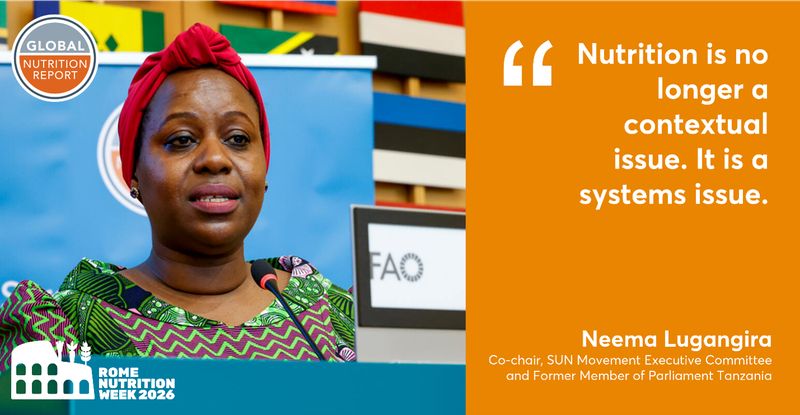
The keynote speaker, Neema Lugangira, Co-chair of the Executive Committee of the Scaling Up Nutrition Movement and former Member of Parliament in Tanzania, set the scene by underscoring the scale of the challenge. As overlapping crises place increasing pressure on systems, she described 2026 as a “defining moment” and made clear that nutrition can no longer be treated in isolation.
She emphasised that progress depends on designing food systems, health systems, social protection and climate strategies to work together, and on building resilience before the next shock hits.
Integration as the pathway to progress
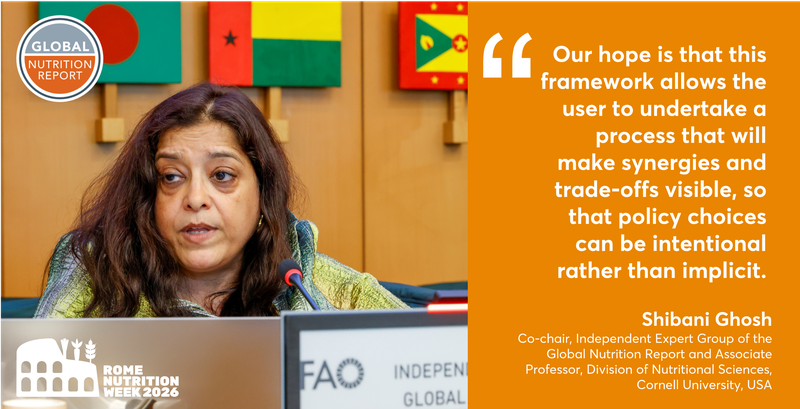
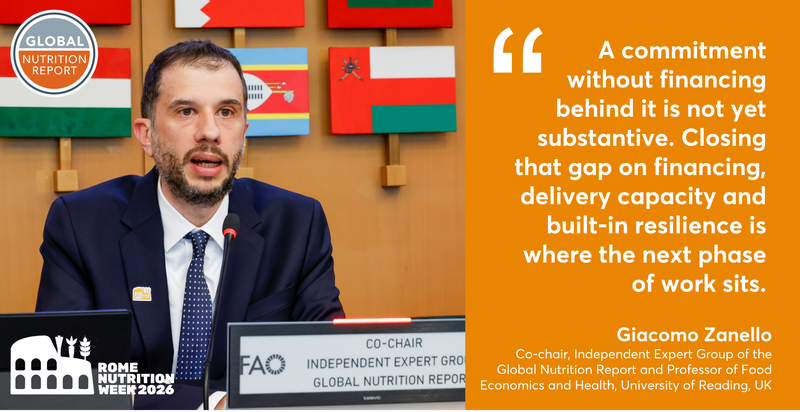
Presenting the report, Shibani Ghosh and Giacomo Zanello, Co-chairs of the GNR Independent Expert Group, outlined the evidence underpinning its central theme: the need for more intentional integration.
They highlighted three key food system strategies—climate-smart agriculture, sustainable diets and reducing food loss and waste—as critical for improving nutrition outcomes and sustainability. However, they emphasised that each involves trade-offs that must be carefully managed. For example, shifts towards plant-rich diets can reduce emissions and non-communicable diseases, but may increase the risk of micronutrient deficiencies without complementary measures. Similarly, agricultural transitions can entail short-term challenges, including reduced yields and income losses, particularly for farmers. These trade-offs vary across regions or communities, underscoring the importance of country-led approaches.
The findings point to a clear conclusion: food system strategies alone are not sufficient. Addressing these trade-offs requires action at the intersection of food and health systems, supported by social protection and aligned financing. The challenge is not only to understand these connections, but to act on them.
From awareness to intentional action
Building on the report’s findings, discussion turned to what they mean in practice. In a panel on policy and system implications, moderated by Theresa Herbold, Senior Policy Advisor at the German Federal Ministry for Economic Cooperation and Development, speakers explored how to move beyond recognising links between systems towards designing policies that explicitly manage trade-offs.
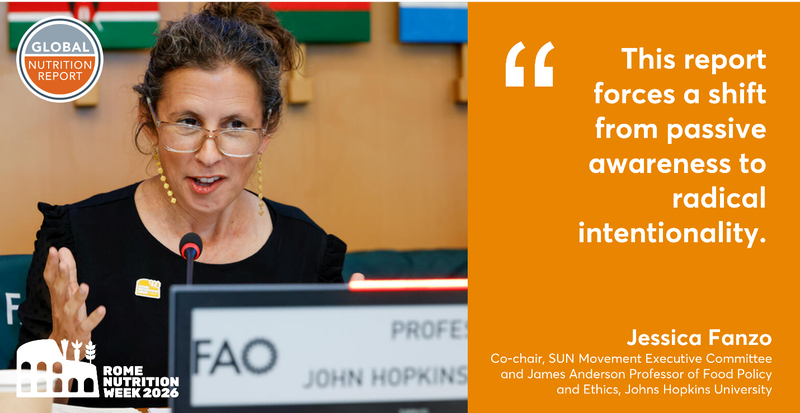
Jessica Fanzo, Professor of Climate and Food Policy at Johns Hopkins University and Co-chair of the Executive Committee of the Scaling Up Nutrition Movement, described this shift as a fundamental change in how nutrition is approached. She cautioned against assuming all climate and nutrition policies will deliver mutual benefits, noting that trade-offs are real and must be addressed directly through evidence, governance and coordinated action.
Katrin Engelhardt of the World Health Organization reinforced that integration is not an abstract concept, but one that can be operationalised through primary health care and broader system reforms. However, she noted that fragmentation across sectors continues to limit progress in practice.
Learning from country experience
The discussion then turned to country experience. In a second panel on country leadership and implementation, moderated by Maarten De Groot, Deputy Permanent Representative of Canada to the UN Agencies in Rome, countries shared how they are pursuing integrated approaches to nutrition and thinking creatively to address current challenges.
Fanja Rakotondrainibe, Madagascar’s National Coordinator for Nutrition, outlined how integrated approaches are being used to respond to climate shocks—from embedding nutrition across national policy frameworks to linking it with early warning systems and disaster risk management, as the country faces recurrent droughts and cyclones.
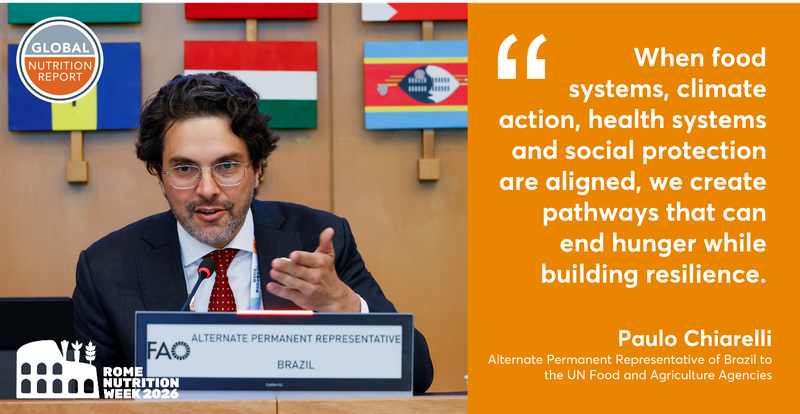
Paulo Chiarelli, Alternate Permanent Representative of Brazil to the UN Food and Agriculture Agencies, highlighted how long-standing programmes, such as school feeding linked to local procurement, demonstrate how nutrition, agriculture and social protection can be aligned to deliver multiple outcomes. He emphasised the importance of financing, governance and legal frameworks in sustaining these efforts.
From South Africa, Jemina Moeng, Agriculture Attaché to the UN Agencies in Rome, described progress in moving beyond siloed approaches, linking health, food systems and social protection to address the country’s triple burden of malnutrition. She stressed the importance of data, local governance and sustained investment in social safety nets.
Across the examples, a clear lesson emerged: integrated systems need to be established before crises occur, so they can respond quickly and protect nutrition outcomes.
The accountability gap
Throughout the discussion, speakers underscored the challenge of moving from commitments to delivery. While commitments to nutrition have increased, many remain insufficiently backed by the financing and systems needed to deliver results.
Speakers emphasised the need to move beyond recognising system linkages to delivering coordinated action in practice. This includes addressing trade-offs explicitly, aligning financing across sectors and strengthening domestic systems capable of responding to shocks.
In this context, integration is not an additional objective, but a necessary approach to delivering measurable outcomes in increasingly complex environments. However, closing this gap will require stronger political leadership, coordinated governance and sustained investment. As UK Member of Parliament David Mundell noted in his closing remarks, without sustained leadership and follow-through, commitments risk remaining statements of intent rather than driving meaningful change.
Turning evidence into action
The report aims to support decision-making and strengthen accountability, but its value ultimately depends on how it is used to inform policy and implementation.
To support this, the report introduces a practical framework to help decision-makers navigate the intersections between food and health systems. The framework clarifies trade-offs, links evidence to policy choices and supports more coherent, integrated action for healthier diets in a changing climate.
This includes using evidence to strengthen commitments, improve coordination and ensure that nutrition is reflected in national and global priorities. As highlighted during the session, the next phase must focus on implementation—ensuring that commitments are delivered, systems are strengthened and progress is sustained in an era of polycrises.