Conceptualising the interconnectedness of food systems and health systems



- Nutrition outcomes under climate change depend on how food and health systems work together during periods of stress and shock. Countries maintaining healthy diets have achieved this by adapting food availability and access while ensuring continuity of essential nutrition and health services.
- Despite growing recognition of the links between food systems, health systems and climate risks, action has often remained fragmented. Breakdowns in coordination, financing, operational capacity and data have limited the ability to translate this interdependence into consistent delivery, especially under crisis conditions.
- The Food and Health Systems for Equitable Nutrition (FHEN) Framework introduced in this chapter brings these strands together by placing healthy diets at the centre of coordinated food and health system action within a changing climate. By focusing on leadership and governance, financing, operational capacity, and research, monitoring and data, it offers a shared way of thinking about how different systems must align to sustain nutrition outcomes when shocks and stressors intensify.
- The framework treats climate and environmental change as an overarching system condition - stressors and shocks acting on both food and health systems - and then translates that into a usable map of supply‑ and demand‑side action channels across both systems. By pairing these channels with four cross-cutting enablers (governance, financing, operational capacity and research, monitoring and data), it helps pinpoint where integration is required, what bottlenecks will prevent delivery and what enabling investments are needed, rather than simply restating that systems are interconnected.
- Unlike frameworks that track sector actions in parallel, this framework links actions and enablers to a single outcome logic spanning environmental soundness and resilience, social equity and gender empowerment and economic prosperity. This makes it easier to translate commitments into policy packages, align donor financing and indicators around a common results architecture and assess substantive accountability rather than procedural compliance alone.
If you would like to know more about any of the terms used in this chapter, you can visit the report glossary.
Evidence throughout this report shows that nutrition outcomes within climate change depend on coordinated action across food and health systems. Countries that maintained nutrition during Covid-19 did so by integrating food system interventions with adapted health service delivery and social protection, not through parallel sectoral responses (Chapter 2). Transitions towards sustainable, nutritious diets require simultaneous food systems transformation and health system support through supplementation, fortification and counselling to ensure micronutrient adequacy (Chapter 3).
Substantive accountability matters more than procedural compliance: embedding financing, cross-sectoral coordination, climate alignment, resilience and equity within the design and delivery of commitments is critical to achieving nutrition outcomes (Chapter 5). Barriers constraining women in food systems directly limit their healthcare-seeking capacity and health system barriers reduce their productive participation in agriculture, creating compounding effects that climate change intensifies (Chapter 4). Yet, commitments remain fragmented. While more than 75% of food systems commitments at the N4G Tokyo 2021 Summit also addressed health, substantive integration was weak. Few commitments included secured financing; governance commitments proved difficult to classify within existing frameworks; and resilience considerations remained marginal, except where commitments explicitly connected both systems (Chapter 6).
This gap between recognition of interdependence and operational integration points to a need for analytical tools that integrate across food, health and climate portfolios while protecting delivery capacity under shocks and stressors. This chapter introduces the FHEN framework that positions healthy diets as an outcome requiring simultaneous, coordinated action across both systems under climate stress (Figure 7.1). The framework is structured around four enabling functions: 1) leadership and governance; 2) financing; 3) operational capacity; and 4) research, monitoring and data. The functions operate across systems to determine the ability to deliver interconnected outcomes (environmental soundness and resilience, social equity and gender empowerment, economic prosperity) that both enable and result from improved nutrition (Box 7.1). With explicit action channels, enabling requirements and outcome interdependencies, the framework provides a tool for designing more integrated commitments, identifying implementation bottlenecks and strengthening accountability for nutrition results within climate change.
Figure 7.1. Achieving healthy diets for all through food and health system transformation within a changing climate
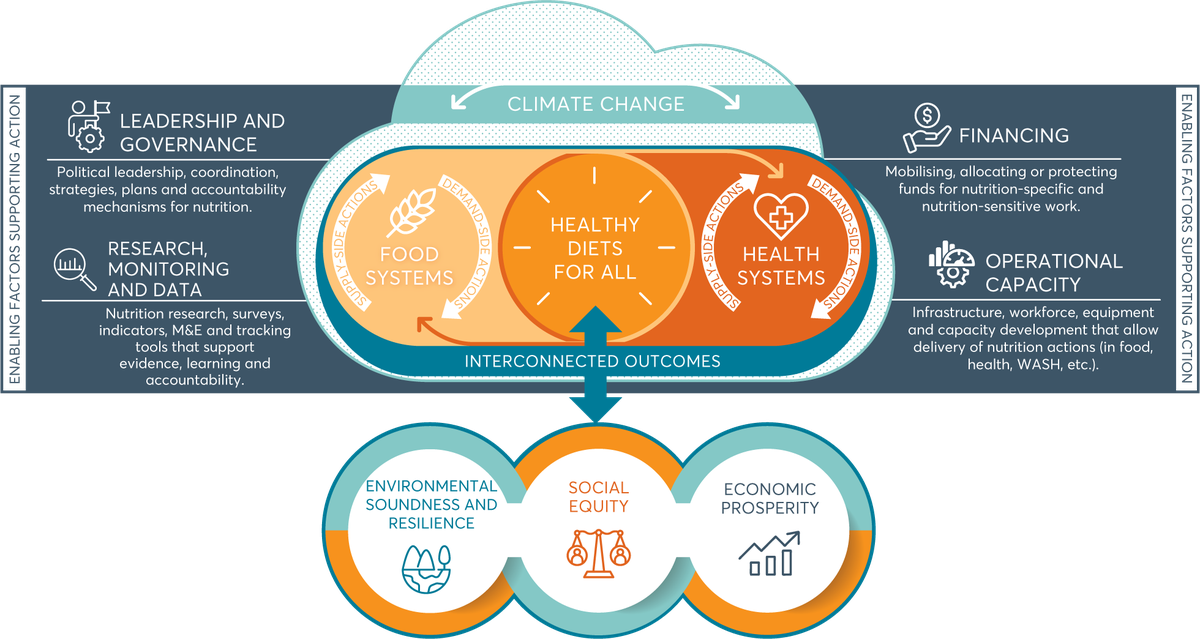
Achieving healthy diets for all through food and health system transformation within a changing climate
Abbreviations: M&E, monitoring and evaluation; WASH, water, sanitation and hygiene.
Healthy diets are both underpinned by, and contribute to, the following outcome domains:
● Environmental soundness and resilience refers to whether actions to improve diets and nutrition are compatible with, and ideally strengthen, the integrity of land, water, biodiversity and climate systems.[1]
● Social equity refers to how benefits and burdens are distributed across and within households, and whether policies and programmes expand the rights, agency and material conditions of women, girls and other marginalised groups.[2]
● Economic prosperity refers to impacts on livelihoods, incomes, productivity and fiscal space, including for small-scale food producers, workers along food supply chains and low-income consumers.[3]
Across these domains, healthy diets are shaped by the stability and sustainability of food, health and social protection systems, and by who can access them during shocks. It also feeds back into all three domains by reducing preventable disease burdens, strengthening human capacity to cope and recover, increasing agency of vulnerable groups and shifting demand towards more nutritious diets that can be produced within environmental limits.[4]
The FHEN framework positions climate and environmental change as the overarching context within which food and health systems operate. Climate pressures affect both systems through long-term stressors such as shifts in temperature and rainfall, rising climate variability and slow-onset degradation of soils, water resources and biodiversity, as well as through acute shocks such as floods, droughts, storms, wildfires and heatwaves. On the supply side, these shocks and stressors disrupt agricultural and fisheries production, damage health and water, sanitation and hygiene infrastructure and interrupt supply chains for food and essential health and nutrition commodities.[5][6] On the demand side, they reduce incomes and employment, increase food price volatility, drive displacement and raise climate-sensitive disease burdens and care costs, creating a persistent risk environment for diets, health services and nutrition[7][8] (Appendix 2 provides more details and examples). The framework specifies action channels within both food and health systems through a supply–demand lens.
Food systems supply-side actions shape what foods are produced, processed, stored and distributed with what stability, safety and nutrient quality under climate stress. This includes climate-smart agriculture and water management, diversification towards nutrient-dense crops, storage and cold chain investments to reduce FLW, in addition to procurement and trade actions that affect the availability and price stability of nutritious foods.
Food systems demand-side actions shape what people can obtain and choose to eat. This includes affordability and purchasing power measures, social protection design and food environment actions that influence relative prices, marketing exposure and access to healthier options in schools, workplaces and retail settings. Demand-side action also covers behaviour and norms change measures that support shifts towards healthy, nutritious diets while maintaining micronutrient adequacy.
Health systems supply-side actions include coverage and quality of essential nutrition actions across the life-course (antenatal care, postnatal care, child health, adolescence and non-communicable disease care); the availability and distribution of trained staff and community platforms; commodities for nutrition interventions; water, sanitation and hygiene and infection control in facilities; and readiness to prevent and manage diet-related non-communicable diseases.[9] Supply-side adaptations during Covid-19 (such as moving acute malnutrition screening to family-based models in Indonesia and shifting vitamin A delivery to community channels in Sierra Leone), enabled continuity when facility-based delivery was disrupted.
Health systems demand-side actions include tackling financial, geographic and social barriers to care; fostering health and nutrition literacy; building trust in providers; and ensuring awareness and uptake of health-linked entitlements and social protection that buffer nutrition shocks. Demand-side barriers, such as needing permission to leave home, lacking funds for transport and time constraints from care work, prevent women from accessing services even when available. Addressing these constraints requires coordination between health system policies and broader gender equity measures.
The supply–demand lens shows points of necessary integration. Dietary shifts, (demand-side food system action) require health system support (supply-side health system action) through counselling and supplementation to ensure nutritional adequacy. Climate-smart agriculture (supply-side food system action) requires health system readiness (supply-side health action) to manage changing disease burdens and nutrition needs. Social protection (demand-side action for both systems) must be designed to reach both food system producers and health service users, particularly women who face barriers in both domains. Resilience (cross-cutting requirement) depends on actions requiring integrated governance rather than parallel sectoral planning: pre-positioning resources, flexible coordination and the ability to adapt delivery modalities across both systems simultaneously.
Whereas important frameworks conceptualising food systems or health systems for nutrition already exist,[10][11][12] this framework is novel in that it simultaneously addresses health and food systems within a changing climate. The framework offers a concrete, interdisciplinary way to address interconnected challenges and polycrises (Box 2.1), consider synergies and trade-offs, align indicators with commitments and deliver multiple outcomes.
In this framework, four enabling functions operate across food and health systems and shape how climate shocks and stressors translate into nutrition outcomes. Drawn from the NAF classification system but extended to explicitly address food–health–climate integration, they are understood as broad categories of actions and capacities that support the design, delivery and accountability of nutrition-relevant policies, programmes and investments.
Leadership and governance refer to actions that shape the way countries and organisations are governed and operate with respect to advancing the food and nutrition agenda across sectors, and to the mechanisms by which food and nutrition policies are decided and actors are held to account.[13] This includes political leadership for nutrition; mandates and coordination arrangements across food, health, social protection, environment and climate portfolios; national nutrition strategies and plans; and formal processes for participation and accountability at national and subnational levels. Governance also concerns equity, participation and protection of vulnerable groups,[14] including whether women, marginalised communities and other disadvantaged groups are represented in decision-making processes that affect diets and health.
The financial function covers actions whose aim is to secure, raise, allocate or protect financial resources and investments for nutrition-specific and nutrition-sensitive actions (Box 3.3). In this framework, this includes domestic public budgets, external assistance and private investment that influence diets and nutrition through food, health and social protection systems. The analysis considers both the volume and the composition of financing, and whether resources are sustained and targeted to populations at the highest nutritional risk.
The operational function refers to the infrastructure and capacity development that enable the delivery of nutrition actions. It covers actions to strengthen, across relevant sectors, the human resources, facilities, equipment, supply chains and training needed to provide nutrition-specific and nutrition-sensitive services. In this report, operational functions also include health facilities and community platforms, frontline workers and their skills, storage and post-harvest infrastructure, water and sanitation services in public facilities and systems for delivering social protection and school meals.
Research, monitoring and data cover actions that improve nutrition research and innovation, and the availability, quality and use of nutrition-relevant data, indicators and surveillance to support learning and accountability. This includes routine data systems, surveys and surveillance, monitoring and evaluation and learning-oriented research. Attention should be paid to whether data systems capture dietary quality, nutritional status, coverage of essential nutrition actions, climate risks and inequities by gender, age and income, and whether this data is used to inform policy and practice.
Share Conceptualising the interconnectedness of food systems and health systems
Downloads
- English Executive Summary - 2026 Global Nutrition Report (PDF 1.1MB) Full Report - 2026 Global Nutrition Report (PDF 7.8MB)
- Spanish Executive Summary - 2026 Global Nutrition Report (Spanish) (PDF 1.3MB) Full Report - 2026 Global Nutrition Report (Spanish) (PDF 8.1MB)
- French Executive Summary - 2026 Global Nutrition Report (French) (PDF 1.1MB) Full Report - 2026 Global Nutrition Report (French) (PDF 7.9MB)
Executive Summary - 2026 Global Nutrition Report
Download a PDF of the executive summary of this year's report
Download the summaryFootnotes
-
Return to source text
Lawrence MA, Baker PI, Pulker CE, Pollard CM. Sustainable, resilient food systems for healthy diets: the transformation agenda. Public Health Nutrition 2019; 22: 2916–20.
-
Return to source text
Conti C, Hall A, Kok K, et al. A quest for questions: the JUSTRA as a matrix for navigating just food system transformations in an era of uncertainty. One Earth 2025; 8: 101178.
-
Return to source text
International Panel of Experts on Sustainable Food Systems & ETC Group. A Long Food Movement: Transforming Food Systems by 2045. Brussels, Belgium: International Panel of Experts on Sustainable Food Systems, 2021. https://www.ipes-food.org/_img/upload/files/
LongFoodMovementEN.pdf.
-
Return to source text
Rockström J, Thilsted SH, Willett WC, et al. The EAT–Lancet Commission on healthy, sustainable, and just food systems. The Lancet 2025; 406: 1625–700.
-
Return to source text
El Khayat M, Halwani DA, Hneiny L, Alameddine I, Haidar MA, Habib RR. Impacts of climate change and heat stress on farmworkers’ health: a scoping review. Frontiers in Public Health 2022; 10: 782811.
-
Return to source text
World Health Organization. WASH and Climate Change Adaptation and Mitigation for Health, 2023-2030. Addenda to the WHO WASHStrategy 2018-2023. Geneva, Switzerland: World Health Organization, 2022. https://www.who.int/publications/m/item/wash-and-climatechange-adaptation-and-mitigation-for-health--2023-2030 (accessed Dec 11, 2025).
-
Return to source text
El Khayat M, Halwani DA, Hneiny L, Alameddine I, Haidar MA, Habib RR. Impacts of Climate Change and Heat Stress on Farmworkers’ Health: A Scoping Review. Front Public Health 2022; 10: 782811.
-
Return to source text
Intergovernmental Panel on Climate Change. Climate Change and Land: IPCC Special Report on Climate Change, Desertification, Land Degradation, Sustainable Land Management, Food Security, and Greenhouse Gas Fluxes in Terrestrial Ecosystems. Cambridge, UK: Cambridge University Press, 2022. https://www.ipcc.ch/srccl (accessed May 6, 2026).
-
Return to source text
World Health Organization. WHO Water, Sanitation and Hygiene Strategy 2018-2025. Geneva, Switzerland: World Health Organization, 2019. https://www.who.int/publications/i/item/WHO-CED-PHE-WSH-18.03 (accessed Dec 11, 2025).
-
Return to source text
Fanzo J, Haddad L, Schneider KR, et al. Viewpoint: rigorous monitoring is necessary to guide food system transformation in the countdown to the 2030 global goals. Food Policy 2021; 104: 102163.
-
Return to source text
High Level Panel of Experts on Food Security and Nutrition. Nutrition and food systems. A report by the High Level Panel of Experts on Food Security and Nutrition of the Committee on World Food Security. Rome, Italy: Food and Agriculture Organization of the United Nations, 2017. https://openknowledge.fao.org/server/api/core/bitstreams/4ac1286e-eef3-4f1d-b5bd-d92f5d1ce738/content.
-
Return to source text
World Health Organization, United Nations Children’s Fund, US Agency for International Development. Multi-sectoral Impacts of the COVID-19 Pandemic on Nutrition Outcomes: An analytical Framework. New York, NY: United Nations Children’s Fund, 2022. https://www.who.int/publications/i/item/9789240041424 (accessed May 6, 2026).
-
Return to source text
Global Nutrition Report. About the Nutrition Accountability Framework. 2025; published online Oct 17. https://globalnutritionreport.org/resources/naf/about/ (accessed Oct 23, 2025).
-
Return to source text
Rao N, Marzi E, Baudish I, Laila A, Conti C, Hicks CC. Citizen voice and state response in the context of food system transformations. Food Policy 2025; 134: 102879.