Alignment of Nutrition for Growth commitments with food systems frameworks, substantive accountability and gender equity



- Commitments made at the Nutrition for Growth Tokyo 2021 and Paris 2025 Summits show strong attention to food systems, with most focusing on diets, nutrition and health and on governance arrangements to support action. In contrast, fewer commitments address resilience and environmental dimensions, reflecting uneven attention across the elements needed for food systems transformation.
- When commitments link food and health systems, the emphasis has tended to fall on dietary outcomes and nutrition‑specific health services, such as counselling, supplementation and treatment. Broader links to agricultural production, resilience and food supply stability are less frequently made, suggesting that integration often centres on service delivery rather than on upstream system conditions.
- Although many commitments involve coordination, advocacy, research and capacity-building, it is unclear how they fit into existing food systems frameworks. This pattern points to a continued focus on processes and inputs, while actions that directly reshape system performance and outcomes remain less clearly articulated.
- While procedural aspects of accountability have strengthened, actual integration remains limited. Commitments that explicitly link food and health systems are more likely to reflect resilience and equity concerns, while financing arrangements and gender‑responsive action continue to lag. This highlights a persistent gap between ambitions and the conditions needed for delivery.
If you would like to know more about any of the terms used in this chapter, you can visit the report glossary.
Since 2013, the global nutrition community, from governments to donors, civil society organisations, international organisations and the private sector, has registered commitments to support achieving the global nutrition targets by 2030 through the N4G Summits. Following an extensive development process, the NAF was launched in 2021 to ensure commitments meet SMART criteria, enabling systematic assessment of both progress towards targets and cross-sectoral coherence.[1]
While commitment tracking has assessed progress over time and monitored how well commitments align with the global nutrition targets, less is known about how commitments align with comprehensive food systems frameworks and how food and health actions intersect within the global commitment architecture.[2][3] Understanding commitment patterns shows where global actors are directing attention and resources, where critical gaps exist and whether the integration called for in policy discussions is reflected in actual commitments.
This chapter examines commitments from the N4G Tokyo 2021 and Paris 2025 Summits to assess 1) whether and how commitments embrace food systems approaches and align with recommended monitoring frameworks; 2) the nature and depth of commitments at the intersection of food and health systems; 3) whether procedural accountability advances translate into substantive accountability that integrates financing, resilience and equity objectives; and 4) the depth of gender integration across nutrition-related sectors.
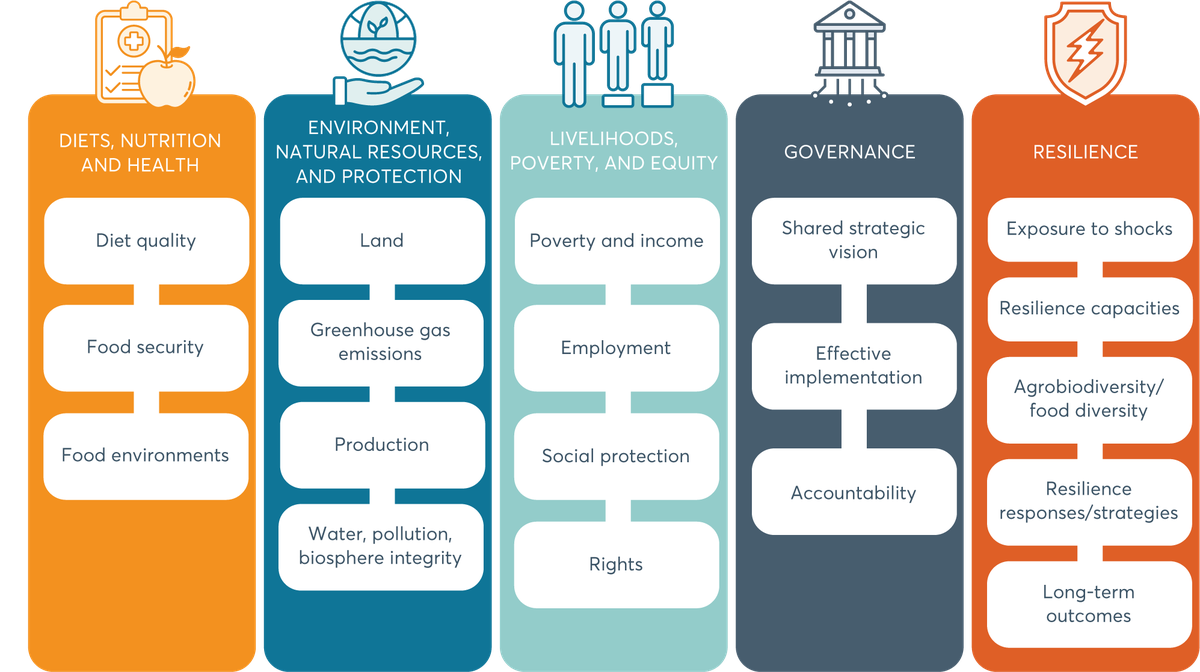
In recent years, substantial progress has been made in developing frameworks and monitoring guidance for assessing food systems transformation. Building on the High-Level Panel of Experts framework as a guiding principle, Fanzo et al. (2021) developed a comprehensive framework that positions nutrition and health as a key thematic area alongside diets.[4] Other themes within this framework include environment, natural resources and production, livelihoods, poverty and equity, governance and resilience. Each thematic area is further classified into specific domains, creating a structure of six thematic areas and 19 domains (Figure 6.1). Schneider et al. (2023) subsequently undertook an extensive consultative process to operationalise this framework, identifying 50 indicators and developing a baseline for monitoring food systems transformation actions globally.[5]
Commitments made at the N4G Tokyo 2021 and Paris 2025 Summits were assessed using this framework and indicator guide. The objectives of the analysis were to assess 1) the extent to which N4G commitments align with the six thematic areas and 19 domains of the food systems framework; 2) whether monitoring indicators selected by commitment makers align with those recommended by Schneider et al.5; and 3) the characteristics and focus areas of commitments positioned at the intersection of food and health systems. This assessment provides the first systematic review of whether the global commitment architecture reflects the integrated, multisectoral approach increasingly recognised as necessary for protecting nutrition within climate change.
Figure 6.1. Food system thematic areas and domains
Food system thematic areas and domains
Source: Fanzo J, Haddad L, Schneider KR, et al. Viewpoint: rigorous monitoring is necessary to guide food system transformation in the countdown to the 2030 global goals. Food Policy 2021; 104: 102163.
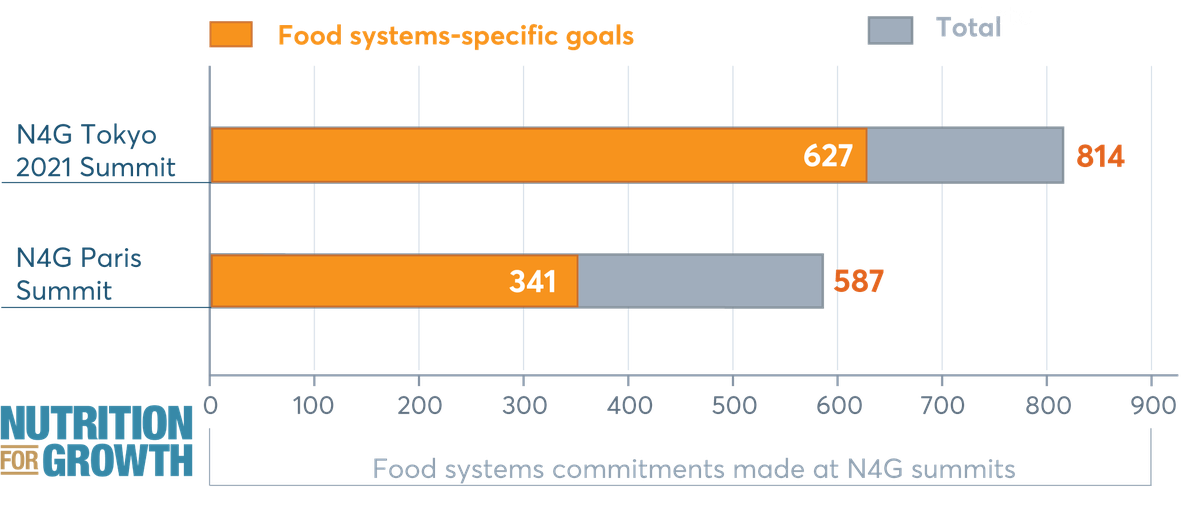
Across the two summits, 1,485 commitments were registered in the NAF.[6] In 2021, 814 commitments were made in Tokyo. In 2025, 587 commitments were made in Paris. Of these, food systems–related commitments were those associated with the 2021 or 2025 UN Food Systems Summit or classified under the N4G thematic area on food systems transformation (nutrition transition to sustainable, climate-smart and resilient food systems). Commitments at the food–health intersection were identified as those classified under both the N4G thematic area of “nutrition, health and social protection” and the food systems transformation theme (either through association with the UN Food Systems Summit or classification under the N4G food systems thematic area).
The emphasis on food systems is evident. More than 75% of commitments at the N4G Tokyo Summit (627 of 814) and over 55% of goals (341 of 587) at the Paris Summit were self-reported by commitment makers as food systems–specific commitments (Figure 6.2). Furthermore, irrespective of the N4G Summit, most food systems commitments were made by country governments (549, 55% of the total) and civil society organisations (177, 18% of the total). Of the 988 commitments categorised as food systems related, 750 were also registered under the N4G health theme (nutrition, health and social protection) and thus addressed both food and health system actions (data not shown).
Figure 6.2. Food systems commitments made at the N4G Tokyo 2021 and Paris 2025 Summits
Food systems commitments made at the N4G Tokyo 2021 and Paris 2025 Summits
Abbreviation: N4G, Nutrition for Growth.
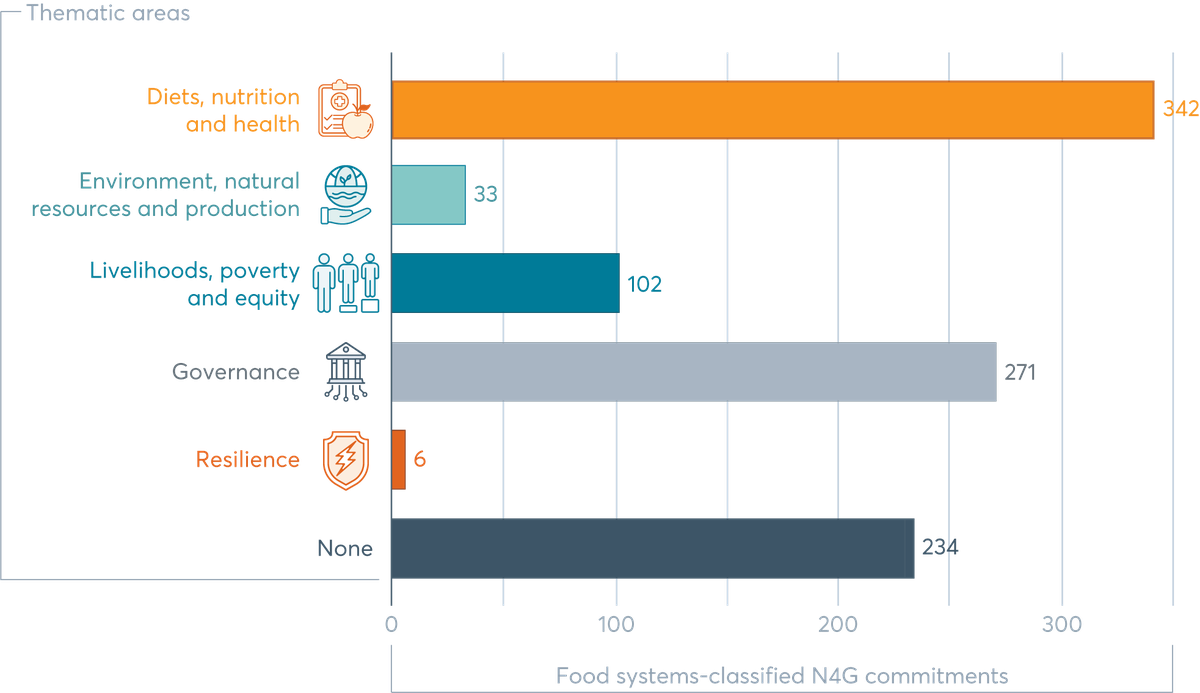
Highest alignment was with the “diets, nutrition and health” theme. The assessment found that most goals (342) aligned with this thematic area, followed by “governance” (271 goals), “livelihoods, poverty and equity” (102 goals) and “environment, natural resources and production” (33 goals). The thematic area of “resilience” had the smallest number of commitments (six goals) (Figure 6.3).
Figure 6.3. Alignment of food systems–classified N4G commitments with the food systems framework thematic areas
Alignment of food systems–classified N4G commitments with the food systems framework thematic areas
Food–health system integration is focused on dietary outcomes and nutrition-specific health services. The concentration in the “diets, nutrition and health” and “governance” thematic areas suggests that when commitment makers explicitly integrate food and health systems, they focus primarily on dietary outcomes and nutrition-specific health services, such as counselling, supplementation or treatment and the governance mechanisms needed to coordinate across sectors. This pattern aligns with evidence that effective nutrition action requires both direct service delivery through health systems and enabling conditions through food systems, bound together by governance structures that facilitate integration.
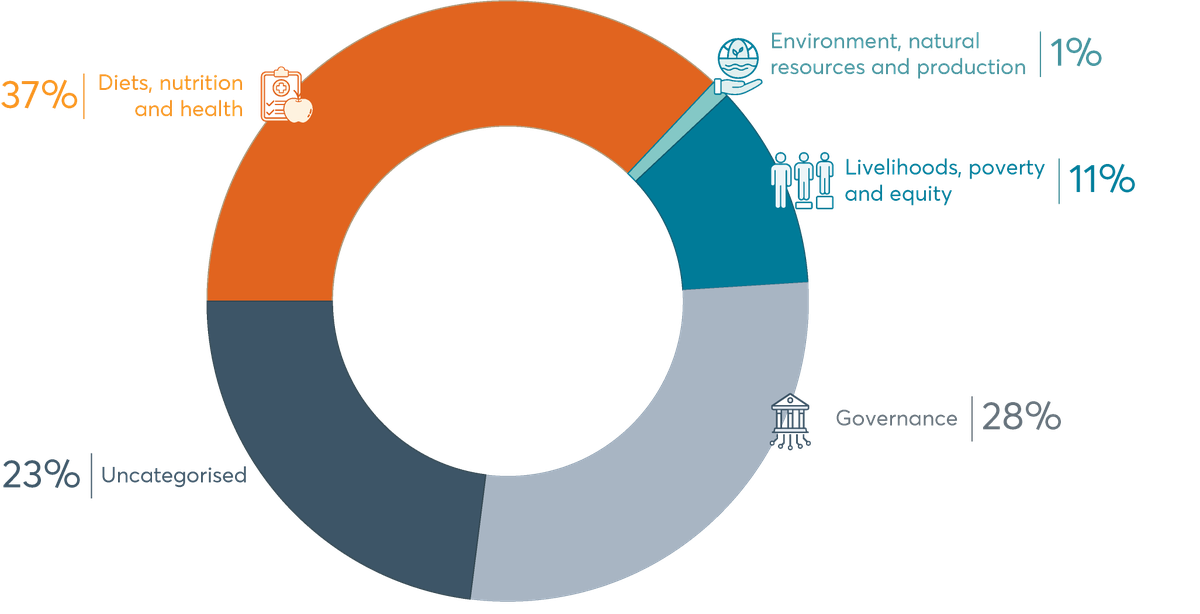
Many food systems goals could not be categorised. There was considerable goal misalignment, both at the level of the thematic areas and within the thematic areas. More than 200 goals identified as being related to food systems did not align with any thematic area and were uncategorised (Figure 6.3). Examples included goals that focused on establishing partnerships, supporting advocacy, conducting research, data collection, education and training and organisational capacity-building. While most commitments could be classified within a thematic area, only 253 of 271 governance goals were classifiable. Of the 1,485 commitments, 750 commitments were positioned at the food–health intersection, revealing a broadly similar but more concentrated pattern (Figure 6.4). Most fell within “diets, nutrition and health” (37%), followed by “governance” (28%), “livelihoods, poverty and equity” (11%) and “environment, natural resources and production” (1%). Notably, approximately 23% of food–health commitments could not be categorised under any thematic area within the food systems framework (Figure 6.4).
Figure 6.4. Alignment of food system–focused commitments with the food systems framework thematic areas
N4G commitments are classified as both food systems commitments and under the “nutrition, health and social protection” theme
Alignment of food- and health system–focused commitments with the food systems framework thematic areas
The 23% of food–health commitments that remain uncategorised signal a significant challenge. These commitments typically focus on establishing partnerships, supporting advocacy, conducting research, collecting data, providing education and training or building organisational. While these enabling activities are important, their prevalence outside the thematic framework suggests that commitment makers may be focusing on process and inputs rather than substantive system changes and outcomes.
Low alignment with monitoring indicators recommended for tracking food systems transformation. Beyond thematic alignment, the assessment examined whether commitment makers selected monitoring indicators consistent with those recommended by Schneider et al. (2023)[7] for tracking food systems transformation. A four-category metric was developed to evaluate alignment between selected and recommended indicators. Only 8% of assessed food systems commitments fell under the high or moderate match categories (39 commitments had high alignment; 25 were moderate), most of which fell under the thematic area of “diets, nutrition and health”. The lowest alignment was found among commitments focused on governance (data not shown).
Indicator misalignment poses challenges beyond measurement. Without appropriate indicators, commitments become difficult to monitor, progress cannot be assessed and accountability weakens. This challenge is particularly acute for food–health–climate integration, where recommended indicators for climate-smart agriculture, resilience and environmental sustainability are relatively new and not yet widely adopted in nutrition monitoring systems. If commitment makers are unfamiliar with these indicators or lack the capacity to measure them, commitments in these areas will remain difficult to track, potentially contributing to the observed under-representation of resilience and production-focused commitments.
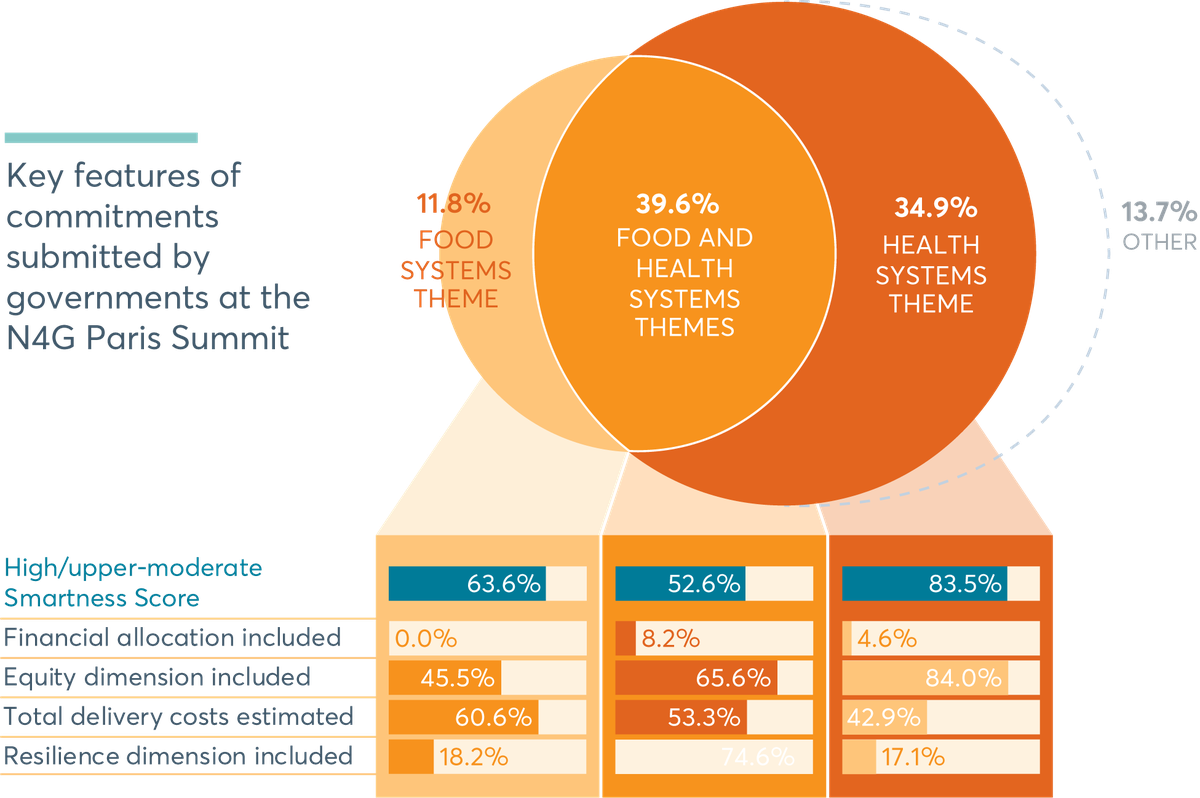
Government commitments from the N4G Paris 2025 Summit provide an empirical test of whether procedural advances (SMART criteria, clear indicators) are accompanied by substantive integration.[8] Focusing on commitments linked to food systems, health systems and their intersection reveals how current governance structures support or constrain delivery capacity under climate stress. Analysis of government commitments confirms that procedural accountability has strengthened significantly: more than half achieved high or upper-moderate SMART scores, rising to greater than 80% among health-focused commitments (Figure 6.5). However, progress towards substantive accountability varied markedly across the four key dimensions.
Financing integration remains weak. None of the food system–only commitments specified secured financial resources at submission. Only 4.6% of health system commitments and 8.2% of integrated food–health commitments included confirmed financing, compared to nearly one-quarter of commitments in other thematic areas. While 40% to 60% of commitments estimated total delivery costs, these projections were rarely backed by secured funds, revealing a persistent gap between planning and fiscal integration. This pattern may reflect both substantive weaknesses and disclosure constraints in government budgeting processes.
Resilience and equity integration show striking variation by commitment type. Fewer than 18% of single-theme commitments (food only or health only) explicitly address resilience. In sharp contrast, 74.6% of commitments that integrate food and health systems include resilience dimensions, suggesting that cross-system governance facilitates more anticipatory and adaptive approaches. Equity considerations follow a different pattern: prominent in 84% of health system commitments but present in only 45.5% of food system–only commitments, highlighting persistent challenges in embedding fairness within food system governance. These findings show that while procedural accountability is now firmly established, substantive accountability is achieved primarily where governance arrangements explicitly link food and health systems.
Figure 6.5. Key features of commitments submitted by governments at the N4G Paris 2025 Summit
Key features of commitments submitted by governments at the N4G Paris 2025 Summit
Abbreviation: N4G, Nutrition for Growth.
Notes: Commitments with a food system theme are those selected as within the “nutrition and transition towards sustainable, climate-smart and resilient food systems” N4G thematic area. Commitments with a health system theme are those selected as within the “nutrition, health and social protection” thematic area. Commitments with food and health systems themes are those selected as within both thematic areas. “Other themes” refers to commitments that were not selected as either the “nutrition and transition towards sustainable, climate-smart and resilient food systems” or the “nutrition, health and social protection” thematic areas.
Patterns observed in the Paris 2025 commitments highlight several areas where governance reform can strengthen impact. On financing, the weak financing integration documented above suggests that strengthening governance connections between nutrition commitments and domestic budgeting processes, climate finance and fiscal planning could improve credibility and sustainability, especially for health systems that need to maintain nutrition services during climate-related shocks. Similarly, better integration of resilience presents a significant scope for improvement.
Although resilience is a well-understood driver of food security and healthy diets within the climate change context, many commitments do not explicitly connect nutrition objectives to resilience. Strengthening these links would allow nutrition policies to benefit from climate planning processes and funding sources while improving the resilience of food supply chains and health service delivery.
Equity considerations are strongest in health system–focused commitments but remain weaker in food system–only commitments. This indicates an opportunity to strengthen governance strategies that consistently incorporate equity across policy design, financing and accountability processes, using health systems as key entry points for reaching vulnerable populations.
The N4G Paris 2025 Summit marked the first time that gender equity was recognised as a key theme in the commitment-making process. An analysis of 631 commitments submitted to the N4G Summit shows how far gender integration has advanced across nutrition-related sectors and where significant gaps remain. Overall, gender integration across commitments is limited. Of the 631 commitments, 70% (440) show no indicated connection to gender. Even among commitments related to agri-food systems and climate, 66% (267 of 406) lack any gender dimension. Despite policy discussions recognising women’s central role in food systems and nutrition, gender considerations remain marginal in most nutrition commitments.
Where gender is addressed, the depth of integration is often shallow. Only 28% of all commitments (177 of 631) include any reference to gender. Among these, most are targeted commitments[9]: 147 commitments, representing 83% of gender-related commitments and 23% of all commitments, focus primarily on women and girls as beneficiaries. In contrast, only 16 commitments (3% of all commitments) are gender inclusive, and just 14 commitments (2%) are gender transformative.
The integration of gender, agri-food systems and climate action is particularly weak. While about half of all commitments (324) include specific actions related to agri-food systems, only 9% (57) include explicit climate action, with an additional 4% making nonspecific climate references. Within agri-food systems and climate-related commitments, gender integration remains low: only 25% (101) include targeted gender actions, and inclusive and transformative actions together account for less than 7%. Additionally, among commitments aimed at women within agri-food systems and climate, nearly one-quarter identify children as the ultimate beneficiaries, reflecting a persistent framing of women’s nutrition mainly through their reproductive and caregiving roles.
The analysis also shows a narrow understanding of women’s roles in agri-food systems. Among the 16 gender-inclusive commitments, only six explicitly identify women as farmers or producers and commit to allocating resources accordingly. Only two commitments address gender gaps in food security or nutrition data systems, and very few acknowledge women’s roles in food processing, value chains or innovation. Male engagement is mentioned in only two transformative commitments, highlighting the limited attention to shifting gender norms and care responsibilities.
Despite these gaps, a few high-ambition commitments show what is achievable. Of the 30 commitments classified as inclusive or transformative, 21 are at the national or subnational level, mainly in low- and middle-income regions. Ten of the 16 inclusive commitments and 11 of the 14 transformative commitments are led by governments, particularly in Africa. These commitments focus on changing opportunity structures, including paid parental leave and breastfeeding support, women’s access to finance and social protection, girls’ education and economic empowerment.
Share Alignment of Nutrition for Growth commitments with food systems frameworks, substantive accountability and gender equity
Downloads
- English Executive Summary - 2026 Global Nutrition Report (PDF 1.1MB) Full Report - 2026 Global Nutrition Report (PDF 7.8MB)
- Spanish Executive Summary - 2026 Global Nutrition Report (Spanish) (PDF 1.3MB) Full Report - 2026 Global Nutrition Report (Spanish) (PDF 8.1MB)
- French Executive Summary - 2026 Global Nutrition Report (French) (PDF 1.1MB) Full Report - 2026 Global Nutrition Report (French) (PDF 7.9MB)
Executive Summary - 2026 Global Nutrition Report
Download a PDF of the executive summary of this year's report
Download the summaryFootnotes
-
Return to source text
Global Nutrition Report. 2022 Global Nutrition Report: Stronger Commitments for Greater Action. Bristol, UK: Development Initiatives, 2022. https://globalnutritionreport.org/reports/2022-global-nutrition-report/ (accessed Oct 23, 2025).
-
Return to source text
Global Nutrition Report. About the Nutrition Accountability Framework. 2025; published online Oct 17. https://globalnutritionreport.org/resources/naf/about/ (accessed Oct 23, 2025).
-
Return to source text
Global Nutrition Report. Mainstreaming nutrition within universal health coverage. In: 2020 Global Nutrition Report: Action on Equity to End Malnutrition. Bristol, UK: Global Nutrition Report, 2020. https://globalnutritionreport.org/reports/2020-global-nutrition-report/
mainstreaming-nutrition-within-universal-health-coverage/ (accessed Oct 23, 2025).
-
Return to source text
Fanzo J, Haddad L, Schneider KR, et al. Viewpoint: rigorous monitoring is necessary to guide food system transformation in the countdown to the 2030 global goals. Food Policy 2021; 104: 102163.
-
Return to source text
Schneider KR, Fanzo J, Haddad L, et al. The state of food systems worldwide in the countdown to 2030. Nature Food 2023; 4: 1090–110.
-
Return to source text
Commitment data in the NAF is self-reported by commitment makers, and the thematic classification system allows multiple selections. Commitments classified under multiple themes tend to have lower SMART scores. The patterns reported in this chapter should therefore be interpreted as reflecting how commitment makers describe their own commitments, which may not correspond exactly with the substantive content of those commitments.
-
Return to source text
Schneider KR, Fanzo J, Haddad L, et al. The state of food systems worldwide in the countdown to 2030. Nature Food 2023; 4: 1090–110.
-
Return to source text
Improvements in commitment design, including greater specificity and stronger thematic alignment, strengthen procedural accountability but are not sufficient on their own to deliver improved nutrition outcomes. Translating procedural gains into substantive accountability, where commitments are backed by financing, delivery capacity and resilience provisions, depends on the governance and institutional conditions analysed in Chapter 5.
-
Return to source text
The degree of gender integration was based on the N4G Paris 2025 Recommendations for Developing Commitments on Nutrition and Gender Equality: Call to Action.
Targeted: Directly addressing the specific nutritional needs of women and girls at different stages of their lives, ensuring support is personalized and effective.
Inclusive: Engaging women and girls, especially those in marginalized or underserved communities, in the decision-making process (design, implementation and/or execution of interventions, programmes or commitments).
Transformative: Working to break down systemic and structural barriers and increase women’s and girls’ agency, access and control over the social and economic resources that influence their nutrition outcomes.