Food systems strategies to adapt to and mitigate the effects of climate change for better nutrition



- Food systems strategies to adapt to and mitigate climate change can generate both synergies and trade‑offs for nutrition, depending on context and design. Across climate‑smart agriculture, sustainable healthy diets and reductions in food loss and waste (FLW), gains in emissions reduction or resilience do not automatically translate into improved nutrition outcomes unless dietary quality, access and equity are explicitly considered.
- Climate‑smart agricultural strategies have contributed to adaptation and mitigation objectives in some settings, but their nutrition impacts vary widely. Outcomes have been more positive where these strategies increase the availability and affordability of diverse, nutrient‑dense foods or protect incomes of food‑insecure households, while productivity and efficiency gains alone have often been associated with uneven benefits and trade‑offs that affect environmental sustainability, inclusion and dietary quality.
- Dietary patterns higher in plant‑based foods and lower in emissions‑intensive animal‑source foods are associated with lower mortality risk and reduced food systems emissions. At the same time, dietary transitions raise important challenges related to affordability, micronutrient adequacy and equity, particularly for vulnerable population groups within low‑ and middle‑income country contexts.
- Outcomes have tended to be more favourable where policies explicitly assess synergies and trade‑offs and combine informational, fiscal and regulatory instruments. Approaches that integrate nutrition objectives, monitor impacts across multiple dimensions and adapt to context have been better positioned to support both human and planetary health.
If you would like to know more about any of the terms used in this chapter, you can visit the report glossary.
Mitigation and adaptation strategies addressing the nutrition-related impacts of climate change can take many forms and may have either synergistic or opposing effects. On the consumption side, strategies supporting dietary change towards healthier and more nutritious diets can contribute to both adaptation and mitigation. Healthy diets tend to be lower in animal-source foods and therefore lower in emissions. This is especially the case in settings where current consumption of animal-source foods is high and dietary shifts towards more diverse, plant-rich diets can reduce emissions while improving health outcomes.
However, the implications of dietary change differ across contexts. In many low- and middle-income countries, the priority may be to improve dietary quality and micronutrient adequacy rather than simply reduce animal-source food intake. On the production side, agricultural efficiency gains, if not implemented in a climate-friendly manner, could lead to greater use of emissions-intensive inputs or greater production of emissions-intensive outputs such as animal-source foods. Reducing FLW has the potential to reduce emissions but could also increase them if waste reduction strategies lead to greater use of energy-intensive refrigeration.
This chapter draws on a narrative review that investigates the impacts of adaptation and mitigation strategies and outlines synergies and trade-offs across three areas: sustainable climate-smart agriculture, sustainable healthy diets and reduction of FLW (Figure 3.1). It also identifies concrete policy options across these three areas (Table 3.1).
Figure 3.1. Adaptation and mitigation strategies focused on climate-smart agriculture, sustainable healthy diets and reducing food loss and waste
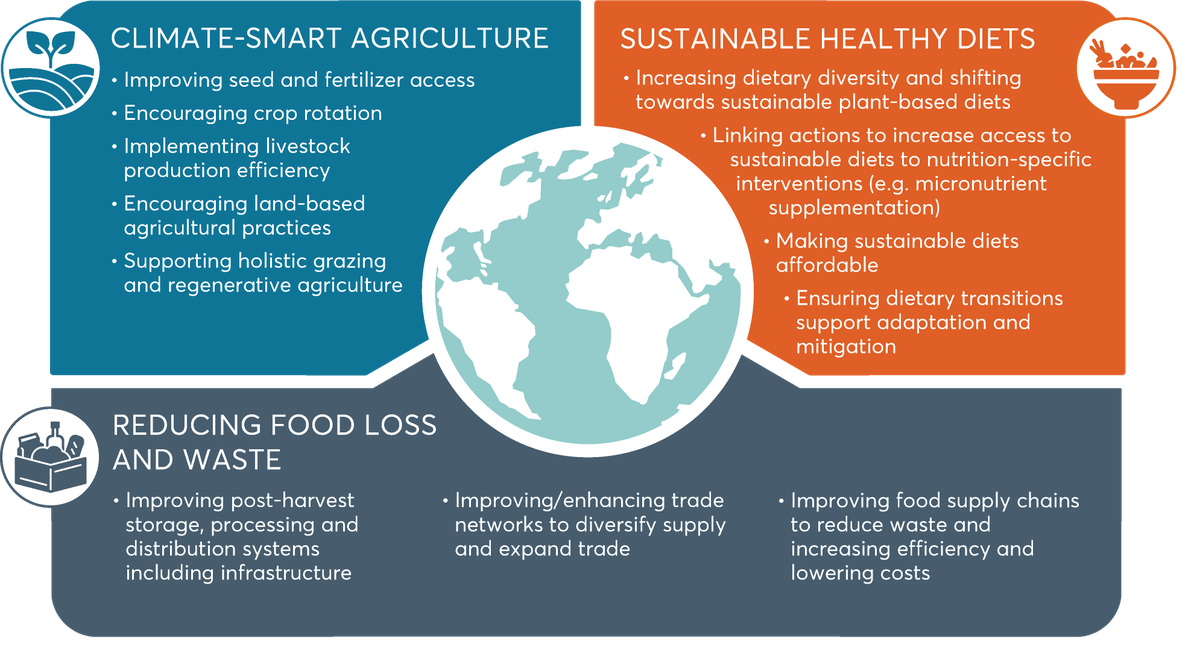
Adaptation and mitigation strategies focused on climate-smart agriculture, sustainable healthy diets and reducing food loss and waste
Table 3.1. Policy options to support adaptation and mitigation strategies
| Policy options |
Climate-smart agriculture |
Sustainable healthy diets |
Reducing food loss and waste |
|---|---|---|---|
| Informational |
● Enhanced information environments and knowledge sharing. ● Data collection and monitoring systems to assess market shifts or climate risks. ● Robust communication strategies. |
● Food-based dietary guidelines to create demand for nutrient-dense foods. ● Front-of-pack labelling to nudge consumers towards healthier choices. |
● Consumer-focused education and awareness generation campaigns; behavioural nudges. ● Awareness generation around household storage; strategies for post-harvest management. |
| Fiscal |
● Redirecting subsidies from the production of animal-source foods to diverse plant-based foods. ● Reorienting national subsidies towards health and sustainability targets. |
● Taxation of sugar-sweetened beverages and saturated fat (to decrease demand). ● Subsidies to lower the cost of specific nutrient-dense foods. |
● Tariff adjustments. ● Strategically structured trade policies and expanded trade networks. ● Subsidies on post-harvest technologies like refrigeration and hermetic bags. ● Subsidies on food reserves to absorb excess production. ● Dynamic pricing at the retail level. ● Demand forecasting. |
|
Regulatory and institutional |
● Regional or farm-level regulatory interventions to support producer behaviour. | ● Investments in school feeding programmes and school nutrition education to reinforce healthy eating behaviours and directly influence dietary quality. |
● Food services portion control regulations. ● Harmonised standards. ● Donation of surplus food to food banks. |
Climate-smart agriculture aims to transform production systems to increase efficiency, enhance resilience and reduce greenhouse gas emissions[1]; however, climate-smart agriculture remains a broad and contested concept. Its flexible definition has allowed very different practices to be labelled ‘climate-smart’, including approaches that rely heavily on external inputs and do not necessarily improve dietary quality, support smallholders or strengthen ecological sustainability.[2]
In this report, climate-smart agriculture is treated as relevant where actions can demonstrate at least some combination of four features: 1) improved resilience to climate stress; 2) lower emissions or environmental pressure; 3) stronger access to or production of nutrient-dense foods; and 4) measurable inclusion of or benefits for smallholder producers and other vulnerable groups. Other approaches, such as agroecology, can overlap substantially with these aims and are therefore considered complementary when they improve resilience, reduce input dependence and support diversified production systems.
Several climate-smart agricultural strategies show global adaptation and mitigation potential, though their effectiveness depends on adoption rates, enabling governance and contextual factors that model-based projections may not fully capture (Figure 3.1). Importantly, gains in productivity or resilience do not automatically translate into better nutrition. Nutrition effects depend on whether these strategies increase the availability, affordability and consumption of diverse and nutrient-dense foods, improve incomes for food-insecure households or reduce exposure to climate-related production shocks.
Adaptation strategies focus on sustaining or increasing yields under climate stress. Better weather and seasonal forecasting can help farmers time planting and input use and reduce losses, and irrigation can stabilise production and support diets where water and energy systems are reliable.[3] Other options include breeding stress-tolerant crop varieties, agroforestry and index insurance.[4] These approaches can involve practical trade-offs, including costs, labour demands, land requirements and unequal access, that shape where they are feasible and who benefits.[5][6]
Mitigation strategies focus on reducing emissions linked to production while maintaining or improving output. In cropping systems, a key route is raising productivity on existing land so that pressure to expand onto new land falls, alongside practices that reduce reliance on synthetic fertilisers, such as legume-based rotations.[7][8][9][10] In livestock systems, emissions can be lowered through better feeding and herd management, and through grazing practices and feed additives that reduce methane output, provided these are affordable and supported by adequate delivery systems.[11] Soil carbon and regenerative approaches may also contribute, but results vary widely with soil type, baseline conditions and consistency of practice over time.[12][13][14][15] From a nutrition perspective, these interventions are more relevant where they support stable access to diverse foods, reduce climate-related production losses or protect smallholder incomes, rather than simply increasing aggregate output.
While most climate-smart agricultural strategies (whether adaptation or mitigation) demonstrate strong co-benefits when implemented under enabling policy conditions, there are trade-offs just as there are synergies. Major synergies and trade-offs along with potential supporting actions are shown in Appendix 1 (Table A1) and a synopsis is presented in Box 3.1.
Climate-smart agricultural interventions operate within complex food, market and health systems. Changes in one domain can generate indirect effects elsewhere. Policymakers therefore need to assess proposed measures against multiple criteria simultaneously: emissions intensity, food availability, dietary quality, income distribution and health risks.
Where trade-offs are likely, complementary tools (such as targeted support, regulatory limits or social protection) should be built in from the start. Continuous monitoring of environmental and nutrition indicators is required to adjust course as needed.
Examples of potential synergies, common trade-offs and design implications are summarised below.
Potential synergies:
- Closing yield gaps and improving input efficiency can limit land expansion, stabilise supply and moderate food price volatility.
- Crop rotation and agroforestry can reduce fertiliser and pesticide use, improve soil health and diversify on-farm food availability.
- Livestock efficiency can lower emissions per unit output and increase the availability of animal-source foods.
- Soil and pasture management can improve resilience to drought and water stress.
Common trade-offs:
- Higher fertiliser use can increase water contamination risks and raise input costs.
- Benefits may concentrate among farmers with credit, irrigation or market access.
- Diversified crops may be sold rather than consumed, limiting dietary gains.
- Efficiency gains in livestock can increase total production (rebound effects).
- Transition to regenerative practices may temporarily reduce yields and incomes.
Design implications:
- Provide subsidies, credit and extension to smallholders.
- Implement emissions intensity benchmarks and land use safeguards.
- Invest in soil testing, nutrient management and water quality monitoring.
- Use social protection to maintain food access during transition periods.
- Integrate dietary guidance and health monitoring where food consumption patterns change.
Policy options for climate-smart agriculture
Effective implementation of climate-smart agriculture requires coordinated engagement across multiple stakeholders to ensure that changes align with nutritional objectives and do not result in maladaptation.[16] This necessitates including explicit nutrition criteria in programme design and monitoring. Without nutrition criteria, climate-smart agricultural policy may improve production or reduce emissions without improving diets, particularly where gains are concentrated in staple crops, export commodities or higher-income producers. Three broad categories of policy instruments can support this: informational approaches, fiscal incentives and regulatory measures (Table 3.1).
Effective information environments and robust data management systems support producers in anticipating market shifts and equip policymakers with data to assess climate risks. For example, improving weather monitoring and production data collection can support accurate forecasting of climate impacts on agriculture. Analysis of Brazilian producer behaviour between 1990 and 2017 demonstrated that better access to knowledge spurred increased investment and higher incomes among farmers.[17] Communicating findings in accessible ways and linking conclusions to policy guidance is another approach to avoiding maladaptive practices, as demonstrated by the Consultative Group on International Agricultural Research, which has facilitated the global transformation of rice production by channelling research findings to both policymakers and producers, tailoring dissemination strategies to regional dietary demand.[18]
Shifting the fiscal environment of food systems can steer production towards healthier and more sustainable outcomes. Redirecting subsidies away from resource-intensive and emissions-intensive animal-source foods towards diverse plant-based foods has demonstrated benefits for both climate and health. A modelling exercise using the Modular Applied GeNeral Equilibrium Tool model projected that redirecting subsidies from animal products to fruits, vegetables, legumes and nuts could cut global greenhouse gas emissions by up to 35% while reducing diet-related mortality, without large losses to individual economic welfare.[19] Similarly, Gautam and colleagues (2022) used the International Food Policy Research Institute’s MIRAGRODEP model to assess the benefits of reorienting national subsidies towards health and sustainability targets, identifying opportunities to reduce the cost of healthy diets and increase producer income.[20] In low-income and subsistence-oriented settings, however, the effects of subsidy reform depend heavily on market access, local production capacity and who captures the gains. Policies are therefore more likely to support nutrition when they expand production and affordability of locally consumed nutrient-dense foods.
Regulatory interventions at both regional and farm levels can set explicit boundaries for producer behaviour, ensuring environmental targets are met while minimising the scope for maladaptive practices. Such measures need to be tailored to the environmental realities of different sectors and regions.[21] For example, Leip and colleagues (2022) used a spatially explicit nitrogen model to assess pathways for achieving the European Union’s Farm to Fork target of halving nitrogen waste. They found this required both technological improvements and significant dietary shifts, particularly reduced consumption of meat and milk.[22] The success of regulatory measures depends on inclusive stakeholder engagement to balance environmental objectives with economic and dietary needs.
Diets high in plant-based foods and low to moderate in animal-based products are significantly associated with reduced risk of all-cause mortality, cardiovascular disease, cancer and type 2 diabetes.[23][24][25][26] Increasing consumption of whole grains, vegetables, fruits, legumes and nuts while reducing consumption of sugar, red meat and processed meat could lead to an estimated 20% reduction in premature mortality, equivalent to approximately 10 million deaths prevented annually.[27][28] Diversifying diets and increasing consumption of nutrient-dense plant-based foods could also mitigate the risks of declining nutrient content in staple crops, projected to occur by 2050.[29][30]
At the same time, reducing the demand for emissions-intensive animal-source foods could reduce food systems emissions by up to 45%.[31] Global modelling studies have estimated a 75% reduction in emissions upon adoption of a fully plant-based diet, and an average reduction of approximately 50% upon adoption of a nutritionally balanced flexitarian diet (a predominantly plant-based diet that includes moderate amounts of animal-source foods).[32] Assessments based on national food-based dietary guidelines (FBDGs) often show smaller mitigation effects, reflecting continued inclusion of meat and dairy within recommended patterns.
Dietary change towards plant-based foods offers strong synergies between climate and health objectives, but it is important to address challenges in achieving nutritional adequacy for some population subgroups (Appendix 1, Table A2). A synopsis of the main synergies, trade-offs and design implications is presented in Box 3.2. Modelling shows that diets higher in animal-source foods could substantially increase greenhouse gas emissions (by an estimated 43% to 64%) and increase diet-related mortality by 1 million excess deaths.[33] Micronutrient gaps would need to be addressed through context-appropriate combinations of diverse foods, fortified foods, supplementation and modest quantities of nutrient-dense animal-source foods where relevant (especially within low- and middle-income country contexts). Additional nutritional requirements for vulnerable groups (e.g. pregnant and lactating women, infants and young children) could instead be met by optimising the consumption of select nutrient-dense foods, such as increasing consumption of green leafy vegetables to improve iron intake or algae to meet vitamin B12 requirements.[34]
A caveat of analysis recommending plant-based dietary shifts is the reliance on adult chronic disease outcomes often drawn from high-income populations, thus introducing a bias given differing health risks, diets and life expectancies. Despite the increasing prevalence of non-communicable diseases globally, this may appear to overlook the immediate priorities in low- and middle-income countries, including those that are the focus of the World Health Assembly targets (undernutrition and maternal and child health). Future research needs to examine/incorporate diverse health outcomes and context-specific evidence. Programmatically, alternative strategies to support sustainable animal-source foods and/or animal-source food alternatives will need to be considered particularly for specific population subgroups (i.e. pregnant and lactating women and infants and young children) to achieve their requirements. A complementary approach is to connect dietary transition strategies with nutrition-specific and nutrition-sensitive health system interventions (Box 3.3), including micronutrient supplementation, fortification programmes and vitamin A supplementation, delivered through antenatal care, child health services and non-communicable disease prevention programmes. Delivery of combinations of direct and indirect interventions through the health sector has been found to be effective in addressing undernutrition.[35][36]
Affordability presents another important trade-off. As of 2021, while 42% of the global population could afford a healthy diet, more than three-quarters of the population in Africa could not.[37] Healthy and sustainable diets are estimated to be 18% to 29% more expensive than current diets in low-income countries – although, affordability could improve under future scenarios through reductions in FLW, socioeconomic development and full-cost accounting of environmental impacts.[38]
Dietary transitions are complex and long-term processes within and beyond single sectors,[39] often suffering from feedback loops and unexpected trade-offs.[40] Examples of potential synergies, common trade-offs and design implications are summarised below.
Potential synergies:
- Shifting towards plant-rich diets can reduce risks of cardiovascular disease, diabetes and certain cancers while lowering food systems emissions.
- Increased consumption of whole grains, legumes, fruits and vegetables can improve micronutrient adequacy and support more diversified production systems.
- Reduced demand for emissions-intensive animal-source foods can ease land and resource pressures.
Common trade-offs:
- Sustainable healthy diets may remain unaffordable for low-income households.
- Rapid reductions in animal-source foods can create micronutrient gaps in specific groups, if not compensated.
- Subsidy reforms may face political resistance from groups that benefit the most from the current food system order.
- Vague dietary guidance yields limited climate gains.
Design implications:
- Combine dietary guidance with subsidy reform and targeted transfers to improve affordability.
- Integrate micronutrient supplementation, fortification and counselling into primary care.
- Consider targeted interventions for specific life cycle groups that support meeting requirements through consumption of animal-source foods or their alternatives.
- Align procurement, labelling and marketing policies with dietary goals.
- Monitor equity and nutrition impacts across income groups during transition.
A 2013 Lancet Maternal and Child Nutrition Series paper[41] distinguishes between nutrition-specific and nutrition-sensitive interventions.
Nutrition-specific: “Interventions or programmes that address the immediate determinants of foetal and child nutrition and development—adequate food and nutrient intake, feeding, caregiving and parenting practices, and low burden of infectious diseases.”
Nutrition-sensitive: “Interventions or programmes that address the underlying determinants of foetal and child nutrition and development—food security; adequate caregiving resources at the maternal, household and community levels; and access to health services and a safe and hygienic environment—and incorporate specific nutrition goals and actions.”
Policy options for sustainable healthy diets
Policy options to support sustainable healthy diets range from informational and fiscal to regulatory approaches[42] (Table 3.1). Informational approaches include FBDGs, front-of-pack labelling and regulation of food advertising. While most national FBDGs recommend abundant quantities of vegetables and fruits, guidance on meat intake is often unclear and nonspecific, and FBDGs rarely shift consumption patterns at scale. Evidence suggests that almost 40% of populations in both high- and low- and middle-income countries do not adhere to their national FBDGs.[43] A meta-analysis of labelling studies found that while labels help consumers identify healthier products, their ability to shift consumers towards healthier choices is limited.[44]
Fiscal approaches can lead to more substantial changes in dietary intake. Although more research is needed, for instance in terms of differentiated effects on different income groups, taxes represent one of the most effective tools for decreasing consumption of unhealthy foods.[45] Increases in the price of sugar-sweetened beverages have reduced demand in several countries that have implemented such policies, and taxes on saturated fats in Denmark have produced similar trends.[46][47] Full-cost accounting, in which food prices reflect the cost of climate change damages associated with emissions, would translate into higher prices and lower demand for high-emissions foods such as red and processed meat and dairy.[48] The key trade-off is the impact of food taxes on food security, as higher prices can make diets more expensive and less accessible for vulnerable groups and low-income countries.[49] This concern is especially important within low- and middle-income contexts, where households often spend a large share of income on food and where taxation without compensatory measures may lessen affordability. In such settings, subsidies for nutrient-dense foods, public procurement, school feeding, social protection and targeted fortification may be more feasible entry points than broad food taxes alone.
Food subsidies that lower the cost of nutrient-dense foods, including fruits, vegetables, legumes and whole grains, could also be considered. A meta-analysis of 22 intervention studies found that a subsidy of 10% led to a 14% increase in consumption of fruits and vegetables.[50] Institutional platforms, including school feeding programmes, offer an important delivery mechanism for improving diets and nutritional outcomes. A systematic review of 16 randomised or quasi-experimental interventions in Europe and North America found that direct provision of foods to students increased combined consumption of fruits and vegetables by 0.28 servings per day.[51] In India, long-term exposure to the Mid-Day Meal Scheme was associated with a 13% to 32% improvement in height-for-age z-scores among children between 2006 and 2016.[52] As the impacts of climate change intensify, enabling healthier and more resilient food choices in schools and other institutional settings will become an increasingly urgent adaptation priority.[53]
As the impacts of climate change intensify, enabling healthier, more resilient food choices in schools and elsewhere will become an increasingly urgent adaptation priority, requiring coordinated action across sectors and actors.
Globally, around 30% of food is lost or wasted, with loss during production and processing particularly acute in low-income regions and waste during retail and consumption more common in high-income regions.[54] Addressing FLW serves a dual purpose: adapting to climate change and mitigating its effects. However, these objectives can sometimes work against each other, and interventions can even backfire from a mitigation perspective. For instance, increased refrigeration and energy-intensive storage systems can raise global greenhouse gas emissions, potentially offsetting gains from FLW reduction.[55] Trade expansion, while supporting adaptation by redistributing surplus food to regions facing production shortfalls, can increase emissions from transport if fossil fuel–dependent logistics are used.[56][57] On the mitigation side, efficiency gains that reduce the need for production and lower emissions can be complicated by economic feedback effects such as lower food prices, as well as political or practical barriers to large-scale implementation.[58]
Adaptation interventions include improved trade, post-harvest storage, processing and distribution systems, which limit losses caused by heat, humidity and pests. These challenges are expected to intensify within climate change.[59][60] Trade allows redistribution of food from surplus to deficit regions and plays a central role in adaptation: diversifying supply chains and widening the number of exporting regions reduces consumer vulnerability to localised shocks, though over-reliance on imports from a small set of countries could heighten risk if climate extremes strike multiple suppliers simultaneously.[61] A global analysis projected that halving FLW could lift 137 million people out of hunger by 2030.[62]
Addressing FLW also has significant mitigation benefits. Scaling back agricultural production through FLW reduction could reduce associated emissions by 11% by 2050, and optimising crop geography could reduce emissions by up to 71%.[63][64] Reduction in retail and consumer FLW carries particularly significant mitigation benefits, as wasted products carry the full emissions burden from production to processing.[65] Full trade liberalisation from 2030 to 2050 could reduce agricultural emissions by up to 33% (structural and political constraints may affect these estimates).[66]
Adaptation strategies also face challenges of alignment between FLW rates and climate-induced losses. While high FLW rates for fruits and vegetables are amenable to intervention, animal-source foods exhibit low baseline levels of FLW, which reduces the potential for adaptation through waste reduction in this category.[67] That said, interventions targeting high-loss commodities such as fruits and vegetables simultaneously enhance adaptation by stabilising supply under climate variability and contribute to mitigation by reducing the need for additional production.[68] Policymakers must carefully consider energy demands, economic feedback, commodity-specific losses and trade-offs to maximise the benefits of FLW interventions. By targeting interventions strategically, focusing on high-loss commodities, adopting low-emissions storage technologies and supporting resilient trade networks, synergies can be enhanced while minimising unintended consequences.
Policy options for reducing food loss and waste
Like climate-smart agriculture and sustainable healthy diets, effective FLW policy spans informational approaches, fiscal incentives and regulatory mechanisms (Table 3.1). On-farm storage improvements, such as the use of hermetic bags and climate-controlled silos, can reduce losses due to spoilage, pests and environmental stressors by approximately 5%, which could in turn reduce hunger by 20%.[69] Evidence from Ethiopia and Kenya suggests that strategic state-subsidised food reserves could reduce maize storage losses by up to 50%.[70][71] Post-harvest processing interventions, including drying, cooling and the use of portable technologies, can increase food availability and reduce greenhouse gas emissions in some circumstances. Use of portable drying technology in Myanmar increased rice production by 7%, improved grain quality by 30% and lowered emissions by up to 40%.[72] A 25% reduction in food loss at the production stage could increase global food availability by 4.3% and decrease global greenhouse gas emissions by 0.7%.[73]
Food waste interventions focus primarily on the retail and consumer stages. Retail-level policies include dynamic pricing, demand forecasting through machine learning, bulk discounting and donation of surplus food to food banks.[74][75][76] Such strategies can decrease food waste while potentially improving dietary diversity and reducing hunger. Consumer-focused informational approaches, including education campaigns, awareness-raising and behavioural nudges, can promote better household storage and consumption patterns, though with mixed long-term effects.[77][78] Investments in household and retail refrigeration can extend the shelf life of perishable foods, particularly fruits and vegetables, although they may increase energy-related emissions if not paired with low-carbon energy sources.[79] Legislative measures, including portion control mandates and incentives for reducing food waste in food service settings, have shown promise in curbing waste while preserving nutrition outcomes.[80]
Trade policy interventions can enhance both adaptation and mitigation objectives. Expanding trade networks allows more efficient producers to supply regions experiencing production shortfalls, thereby increasing resilience to climate-induced shocks and improving dietary diversity.[81][82] However, trade policies must be carefully structured to preserve resilience, as over-reliance on a limited set of staple imports exposes countries to simultaneous climate shocks.[83] Policy measures may include harmonised standards, tariff adjustments and infrastructure investments to facilitate efficient cross-border distribution while mitigating transport-related emissions.[84] A combination of storage and processing improvements, consumer- and retailer-focused waste reduction interventions and strategically structured trade policies can provide concrete avenues for enhancing the efficiency, resilience and sustainability of the food supply chain. The main synergies, trade-offs and design implications across these interventions are summarised in Box 3.4. The success of the food systems strategies, whether climate-smart agriculture, ensuring sustainable healthy diets or reducing loss and waste, requires engagement with the private sector. Private-sector accountability in delivering food systems actions is presented in Box 3.5.
Reducing food loss and waste requires considerable and interconnected changes to storage systems, logistics, trade patterns and price dynamics. Examples of potential synergies, common trade-offs and design implications are summarised below.
Potential synergies:
- Improved storage and processing can reduce losses from heat, humidity and pests, stabilising supply and moderating seasonal price volatility.
- More efficient supply chains reduce waste where products embody high production emissions, improving system-wide efficiency.
- Trade can redistribute surplus food to deficit regions during climate shocks and diversify sourcing.
Common trade-offs:
- Energy-intensive refrigeration and long-distance transport can increase emissions.
- Infrastructure investments may exclude smallholders and small enterprises.
- Trade expansion can undermine local producers if poorly managed.
- Lower prices from efficiency gains may increase consumption and offset emissions savings.
Design implications:
- Prioritise low-emissions storage and cooling technologies.
- Provide shared or subsidised infrastructure for small-scale actors.
- Invest in low-carbon logistics and diversified trade partnerships.
- Link food loss and waste reduction with food assistance and nutrition programmes.
- Track emissions, price effects and equity outcomes during rollout.
Nutrition performance of the private sector through accountability measures and improved incentives and regulations needs to be strengthened. Coordinated action across all actors, including businesses, governments, investors and consumers, is needed to ensure that nutritious food is more available, affordable, desirable and accessible. Markets will change when governments, international institutions, investors and businesses leverage the full range of private-sector tools, innovations and financial instruments to achieve access to nutritious foods for healthier diets. The guiding principles for private-sector engagement were agreed upon by dozens of actors at the Nutrition for Growth Paris 2025 Summit.[85]
Several steps are required to operationalise greater accountability, better incentives and enhanced regulation. First, civil society and international organisations should develop guiding principles for increasing transparent and accountable engagement with the private sector. Several existing benchmarks can be adapted and leveraged to push for improved corporate engagement and healthier food portfolios to achieve sustainable healthy dietary goals, with transparent reporting on nutrition, marketing and emissions impacts. Second, investors, development finance institutions and governments can provide financial incentives to support local private-sector food systems actors that produce nutritious, healthy and safe foods and that measurably demonstrate product portfolio–level improvements.[86] Third, more investments are required for climate-resilient and nutrition-sensitive (perishable and nonperishable healthy foods) supply chains, particularly post-harvest infrastructure in low-income settings. Fourth, governments can introduce evidence-based nutrient profile models to develop and implement relevant taxation of unhealthy food products while initiating mandatory schemes to improve company portfolios and marketing practices. [87]
Governments can require food companies to disclose annually the healthiness of their product portfolios against these national evidence-based nutrient profiling models. Finally, governments and development finance partners can rebalance agricultural subsidies to support healthy diets from sustainable agri-food systems by favouring healthy foods (fresh fruits and vegetables, beans and legumes, diverse nutritious staple foods and nutritious animal-source foods) within some contexts.
Share Food systems strategies to adapt to and mitigate the effects of climate change for better nutrition
Downloads
- English Executive Summary - 2026 Global Nutrition Report (PDF 1.1MB) Full Report - 2026 Global Nutrition Report (PDF 7.8MB)
- Spanish Executive Summary - 2026 Global Nutrition Report (Spanish) (PDF 1.3MB) Full Report - 2026 Global Nutrition Report (Spanish) (PDF 8.1MB)
- French Executive Summary - 2026 Global Nutrition Report (French) (PDF 1.1MB) Full Report - 2026 Global Nutrition Report (French) (PDF 7.9MB)
Executive Summary - 2026 Global Nutrition Report
Download a PDF of the executive summary of this year's report
Download the summaryFootnotes
-
Return to source text
Food and Agriculture Organization of the United Nations. Climate Smart Agriculture Sourcebook. Rome, Italy: Food and Agriculture Organization of the United Nations, 2013. https://openknowledge.fao.org/server/api/core/bitstreams/b21f2087-f398-4718-8461-b92afc82e617/content.
-
Return to source text
Taylor M. Climate-smart agriculture: what is it good for? The Journal of Peasant Studies 2018; 45: 89–107.
-
Return to source text
Pieralli S, Arsov S, Elleby C, Pérez Domínguez I, Farkas B. The potential for yield improvements in developing countries to reduce their exposure to extreme weather shocks in exporting countries. Journal of Agricultural Economics 2025; 76: 268–81.
-
Return to source text
Zabel F, Müller C, Elliott J, et al. Large potential for crop production adaptation depends on available future varieties. Global Change Biology 2021; 27: 3870–82.
-
Return to source text
Jensen N, Barrett C. Agricultural index insurance for development. Applied Economic Perspectives and Policy 2017; 39: 1990219.
-
Return to source text
Kay S, Rega C, Moreno G, et al. Agroforestry creates carbon sinks whilst enhancing the environment in agricultural landscapes in Europe. Land Use Policy 2019; 83: 581–93.
-
Return to source text
Food and Agriculture Organization of the United Nations. Climate Smart Agriculture Sourcebook. Rome, Italy: Food and Agriculture Organization of the United Nations, 2013. https://openknowledge.fao.org/server/api/core/bitstreams/b21f2087-f398-4718-8461-b92afc82e617/content.
-
Return to source text
Jensen ES, Carlsson G, Hauggaard-Nielsen H. Intercropping of grain legumes and cereals improves the use of soil N resources and reduces the requirement for synthetic fertilizer N: a global-scale analysis. Agronomy for Sustainable Development 2020; 40: 5.
-
Return to source text
Menegat S, Ledo A, Tirado R. Greenhouse gas emissions from global production and use of nitrogen synthetic fertilisers in agriculture. Scientific Reports 2022; 12: 14490.
-
Return to source text
Suh S, Johnson JA, Tambjerg L, et al. Closing yield gap is crucial to avoid potential surge in global carbon emissions. Global Environmental Change 2020; 63: 102100.
-
Return to source text
Mottet A, de Haan C, Falcucci A, Tempio G, Opio C, Gerber P. Livestock: on our plates or eating at our table? A new analysis of the feed/food debate. Global Food Security 2017; 14: 1–8.
-
Return to source text
Baveye PC, Otten W, Kravchenko A, et al. Emergent properties of microbial activity in heterogeneous soil microenvironments: different research approaches are slowly converging, yet major challenges remain. Frontiers in Microbiology 2018; 9.
-
Return to source text
Poulton P, Johnston J, Macdonald A, White R, Powlson D. Major limitations to achieving “4 per 1000” increases in soil organic carbon stock in temperate regions: evidence from long-term experiments at Rothamsted Research, United Kingdom. Global Change Biology 2018; 24: 2563–84.
-
Return to source text
Santos RS, Hamilton EK, Stanley PL, Paustian K, Cotrufo MF, Zhang Y. Simulating adaptive grazing management on soil organic carbon in the Southeast U.S.A. using MEMS 2. Journal of Environmental Management 2024; 365: 121657.
-
Return to source text
Smith P. Soil carbon sequestration and biochar as negative emission technologies. Global Change Biology 2016; 22: 1315–24.
-
Return to source text
Raza A, Razzaq A, Mehmood SS, et al. Impact of climate change on crops adaptation and strategies to tackle its outcome: a review. Plants 2019; 8: 34.
-
Return to source text
Gori Maia A, Burney JA, Morales Martínez JD, Cesano D. Improving production and quality of life for smallholder farmers through a climate resilience program: an experience in the Brazilian Sertão. PLOS ONE 2021; 16: e0251531.
-
Return to source text
Mishra AK, Pede VO, Arouna A, et al. Helping feed the world with rice innovations: CGIAR research adoption and socioeconomic impact on farmers. Global Food Security 2022; 33: 100628.
-
Return to source text
Springmann M, Freund F. Options for reforming agricultural subsidies from health, climate, and economic perspectives. Nature Communications 2022; 13: 82.
-
Return to source text
Gautam M, Laborde Debucquet D, Mamun A, Martin W, Piñeiro V, Vos R. Repurposing agricultural policies and support: options to transform agriculture and food systems to better serve the health of people, economies, and the planet. Washington, DC: International Food Policy Research Institute, 2022.
-
Return to source text
Li C, Pradhan P, Wu X, et al. Livestock sector can threaten planetary boundaries without regionally differentiated strategies. Journal of Environmental Management 2024; 370: 122444.
-
Return to source text
Leip A, Caldeira C, Corrado S, et al. Halving nitrogen waste in the European Union food systems requires both dietary shifts and farm level actions. Global Food Security 2022; 35: 100648.
-
Return to source text
Ahmad S, Moorthy MV, Lee I-M, et al. Mediterranean diet adherence and risk of all-cause mortality in women. JAMA Network Open 2024; 7: e2414322.
-
Return to source text
English LK, Ard JD, Bailey RL, et al. Evaluation of dietary patterns and all-cause mortality: a systematic review. JAMA Network Open 2021; 4: e2122277.
-
Return to source text
Schwingshackl L, Bogensberger B, Hoffmann G. Diet quality as assessed by the healthy eating index, alternate healthy eating index, dietary approaches to stop hypertension score, and health outcomes: an updated systematic review and meta-analysis of cohort studies. Journal of the Academy of Nutrition and Dietetics 2018; 118: 74-100.e11.
-
Return to source text
Willett W, Rockström J, Loken B, et al. Food in the Anthropocene: the EAT–Lancet Commission on healthy diets from sustainable food systems. The Lancet 2019; 393: 447–92.
-
Return to source text
Springmann M, Spajic L, Clark MA, et al. The healthiness and sustainability of national and global food based dietary guidelines: modelling study. BMJ 2020; 370: m2322.
-
Return to source text
Springmann M, Mason-D’Croz D, Robinson S, et al. Health-motivated taxes on red and processed meat: a modelling study on optimal tax levels and associated health impacts. PLOS ONE 2018; 13: e0204139.
-
Return to source text
Beach RH, Sulser TB, Crimmins A, et al. Combining the effects of increased atmospheric carbon dioxide on protein, iron, and zinc availability and projected climate change on global diets: a modelling study. The Lancet Planetary Health 2019; 3: e307–17.
-
Return to source text
Smith MR, Myers SS. Impact of anthropogenic CO2 emissions on global human nutrition. Nature Climate Change 2018; 8: 834–9.
-
Return to source text
Aleksandrowicz L, Green R, Joy EJM, Smith P, Haines A. The impacts of dietary change on greenhouse gas emissions, land use, water use, and health: a systematic review. PLOS ONE 2016; 11: e0165797.
-
Return to source text
Springmann M, Clark M, Mason-D’Croz D, et al. Options for keeping the food system within environmental limits. Nature 2018; 562: 519–25.
-
Return to source text
Springmann M. Eating a nutritionally adequate diet is possible without wrecking long-term health, the planet, or the pocket. The Lancet Planetary Health 2023; 7: e544.
-
Return to source text
Springmann M, Auclair O, Bajaj S, et al. Many diets for many people: planetary health diets and their health and environmental impacts at global, regional, national, and demographic levels. Research Square. 2025; published online Sep 9. https://www.researchsquare.com/article/rs-6474232/v1 (accessed May 6, 2026).
-
Return to source text
Bhutta ZA, Das JK, Rizvi A, et al. Evidence-based interventions for improvement of maternal and child nutrition: what can be done and at what cost? The Lancet 2013; 382: 452–77.
-
Return to source text
Keats EC, Das JK, Salam RA, et al. Effective interventions to address maternal and child malnutrition: an update of the evidence. The Lancet Child & Adolescent Health 2021; 5: 367–84.
-
Return to source text
The State of Food and Agriculture 2023. Rome, Italy: Food and Agriculture Organization of the United Nations, 2023. DOI:10.4060/cc7724en.
-
Return to source text
Springmann M, Clark MA, Rayner M, Scarborough P, Webb P. The global and regional costs of healthy and sustainable dietary patterns: a modelling study. The Lancet Planetary Health 2021; 5: e797–807.
-
Return to source text
Rockström J, Thilsted SH, Willett WC, et al. The EAT-Lancet Commission on healthy, sustainable, and just food systems. The Lancet 2025; 406: 1625–700.
-
Return to source text
Mausch K, Hall A, Hambloch C, et al. Foundations of a learning system for food system transformation under uncertainty. Food Security 2025; 17: 1669–85.
-
Return to source text
Ruel MT, Alderman H. Nutrition-sensitive interventions and programmes: how can they help to accelerate progress in improving maternal and child nutrition? The Lancet 2013; 382: 536–51.
-
Return to source text
Mozaffarian D, Afshin A, Benowitz NL, et al. Population approaches to improve diet, physical activity, and smoking habits: a scientific statement from the American Heart Association. Circulation 2012; 126: 1514–63.
-
Return to source text
Leme ACB, Hou S, Fisberg RM, Fisberg M, Haines J. Adherence to food-based dietary guidelines: a systemic review of high-income and low- and middle-income countries. Nutrients 2021; 13: 1038.
-
Return to source text
Ikonen I, Sotgiu F, Aydinli A, Verlegh PWJ. Consumer effects of front-of-package nutrition labeling: an interdisciplinary meta-analysis. Journal of the Academy of Marketing Science 2020; 48: 360–83.
-
Return to source text
Andreyeva T, Marple K, Marinello S, Moore TE, Powell LM. Outcomes following taxation of sugar-sweetened beverages: a systematic review and meta-analysis. JAMA Network Open 2022; 5: e2215276.
-
Return to source text
Andreyeva T, Marple K, Marinello S, Moore TE, Powell LM. Outcomes following taxation of sugar-sweetened beverages: a systematic review and meta-analysis. JAMA Network Open 2022; 5: e2215276.
-
Return to source text
Jensen JD, Smed S, Aarup L, Nielsen E. Effects of the Danish saturated fat tax on the demand for meat and dairy products. Public Health Nutrition 2016; 19: 3085–94.
-
Return to source text
Springmann M, Mason-D’Croz D, Robinson S, et al. Health-motivated taxes on red and processed meat: a modelling study on optimal tax levels and associated health impacts. PLOS ONE 2018; 13: e0204139.
-
Return to source text
Thow AM, Downs S, Jan S. A systematic review of the effectiveness of food taxes and subsidies to improve diets: understanding the recent evidence. Nutrition Reviews 2014; 72: 551–65.
-
Return to source text
Afshin A, Peñalvo JL, Del Gobbo L, et al. The prospective impact of food pricing on improving dietary consumption: a systematic review and meta-analysis. PLOS ONE 2017; 12: e0172277.
-
Return to source text
Micha R, Karageorgou D, Bakogianni I, et al. Effectiveness of school food environment policies on children’s dietary behaviors: a systematic review and meta-analysis. PLOS ONE 2018; 13: e0194555.
-
Return to source text
Chakrabarti S, Scott SP, Alderman H, Menon P, Gilligan DO. Intergenerational nutrition benefits of India’s national school feeding program. Nature Communications 2021; 12: 4248.
-
Return to source text
Fanzo J, Rudie C, Sigman I, et al. Sustainable food systems and nutrition in the 21st century: a report from the 22nd annual Harvard Nutrition Obesity Symposium. The American Journal of Clinical Nutrition 2022; 115: 18–33.
-
Return to source text
Spang ES, Moreno LC, Pace SA, et al. Food loss and waste: measurement, drivers, and solutions. Annual Review of Environment and Resources 2019; 44: 117–56.
-
Return to source text
Friedman-Heiman A, Miller SA. The impact of refrigeration on food losses and associated greenhouse gas emissions throughout the supply chain. Environmental Research Letters 2024; 19: 064038.
-
Return to source text
Beyer RM, Hua F, Martin PA, Manica A, Rademacher T. Relocating croplands could drastically reduce the environmental impacts of global food production. Communications Earth & Environment 2022; 3: 49.
-
Return to source text
Guerrero S, Henderson B, Hugo V, Janssens C, Havlík P, Palazzo A. The impacts of agricultural trade and support policy reform on climate change adaptation and environmental performance. Paris, France: Organisation for Economic Co-operation and Development, 2022. https://www.oecd.org/en/publications/2022/06/theimpacts-of-agricultural-trade-and-support-policy-reform-on-climate-change-adaptation-and-environmentalperformance_
562aaec1.html (accessed Sept 16, 2025).
-
Return to source text
von Lampe M, Willenbockel D, Ahammad H, et al. Why do global long-term scenarios for agriculture differ? An overview of the AgMIP Global Economic Model Intercomparison. Agricultural Economics 2014; 45: 3–20.
-
Return to source text
Kuiper M, Cui HD. Using food loss reduction to reach food security and environmental objectives – A search for promising leverage points. Food Policy 2021; 98: 101915.
-
Return to source text
Silvestrini MM, Smith NW, Sarti FM. Evolution of global food trade network and its effects on population nutritional status. Current Research in Food Science 2023; 6: 100517.
-
Return to source text
Kummu M, Kinnunen P, Lehikoinen E, et al. Interplay of trade and food system resilience: gains on supply diversity over time at the cost of trade independency. Global Food Security 2020; 24: 100360.
-
Return to source text
Nenert C, González D, Giner C, Gay S, Elasri A. The potential effects of reducing food loss and waste: Impacts on the triple challenge and cost-benefits analysis. Paris, France: Organisation for Economic Co-operation and Development, 2025 DOI:10.1787/bd2aedc6-en.
-
Return to source text
Springmann M, Clark M, Mason-D’Croz D, et al. Options for keeping the food system within environmental limits. Nature 2018; 562: 519–25.
-
Return to source text
Beyer RM, Hua F, Martin PA, Manica A, Rademacher T. Relocating croplands could drastically reduce the environmental impacts of global food production. Communications Earth & Environment 2022; 3: 49.
-
Return to source text
Getaneh Y, Nigusse Y, Abera W. Ethiopia. In: How to Reduce Agrifood Systems’ Future Hidden Costs? A Multicountry Case Study – State of Food and Agriculture (SOFA). Rome, Italy: Food and Agriculture Organization of the United Nations, 2024: 127–43.
-
Return to source text
Guerrero S, Henderson B, Hugo V, Janssens C, Havlík P, Palazzo A. The impacts of agricultural trade and support policy reform on climate change adaptation and environmental performance. Paris, France: Organisation for Economic Co-operation and Development, 2022 https://www.oecd.org/en/publications/2022/06/theimpacts-of-agricultural-trade-and-support-policy-reform-on-climate-change-adaptation-and-environmentalperformance_562aaec1.html (accessed Sept 16, 2025).
-
Return to source text
Spang ES, Moreno LC, Pace SA, et al. Food loss and waste: measurement, drivers, and solutions. Annual Review of Environment and Resources 2019; 44: 117–56.
-
Return to source text
De Jong B, Boysen-Urban K, De Laurentiis V, et al. Assessing the economic, social and environmental impacts of food waste reduction targets – A model-based analysis. Luxembourg: Publications Office of the European Union, 2023. DOI:10.2760/77251.
-
Return to source text
Brander M, Bernauer T, Huss M. Improved on-farm storage reduces seasonal food insecurity of smallholder farmer households: evidence from a randomized control trial in Tanzania. Food Policy 2021; 98: 101891.
-
Return to source text
De Groote H, Kimenju SC, Likhayo P, Kanampiu F, Tefera T, Hellin J. Effectiveness of hermetic systems in controlling maize storage pests in Kenya. Journal of Stored Products Research 2013; 53: 27–36.
-
Return to source text
World Bank, Food and Agriculture Organization of the United Nations, World Food Programme. Strengthening Strategic Grain Reserves to Enhance Food Security. Washington, DC: World Bank, 2025. DOI:10.1596/43131.
-
Return to source text
Gummert M, Nguyen-Van-Hung, Cabardo C, et al. Assessment of post-harvest losses and carbon footprint in intensive lowland rice production in Myanmar. Scientific Reports 2020; 10: 19797.
-
Return to source text
Kuiper M, Cui HD. Using food loss reduction to reach food security and environmental objectives – A search for promising leverage points. Food Policy 2021; 98: 101915.
-
Return to source text
Penalver JG, Armijos A, Soret B, Aldaya MM. Food banks against climate change, a solution that works: a case study in Navarra, Spain. Foods 2022; 11: 3645.
-
Return to source text
Seyam A, Mathew SS, Du B, Barachi ME, Shen J. A stacking ensemble model for food demand forecasting: a preventative approach to food waste reduction. Cleaner Logistics and Supply Chain 2025; 15: 100225.
-
Return to source text
Tsalis G, Jensen BB, Wakeman SW, Aschemann-Witzel J. Promoting food for the trash bin? A review of the literature on retail price promotions and household-level food waste. Sustainability 2021; 13: 4018.
-
Return to source text
Jobson D, Karunasena GG, Nabi N, Pearson D, Dunstan E. A systematic review of pre-post studies testing behaviour change interventions to reduce consumer food waste in the household. Sustainability 2024; 16: 1963.
-
Return to source text
Liechti C, Mack G, Ammann J. A systematic literature review of impactful food waste interventions at the consumer level. Sustainable Production and Consumption 2024; 52: 552–65.
-
Return to source text
Broeze J, Guo X, Axmann H. Trade-off analyses of food loss and waste reduction and greenhouse gas emissions in food supply chains. Sustainability 2023; 15: 8531.
-
Return to source text
Nicastro R, Carillo P. Food loss and waste prevention strategies from farm to fork. Sustainability 2021; 13: 5443.
-
Return to source text
Springmann M. Eating a nutritionally adequate diet is possible without wrecking long-term health, the planet, or the pocket. The Lancet Planetary Health 2023; 7: e544.
-
Return to source text
Silvestrini MM, Smith NW, Sarti FM. Evolution of global food trade network and its effects on population nutritional status. Current Research in Food Science 2023; 6: 100517.
-
Return to source text
Kummu M, Kinnunen P, Lehikoinen E, et al. Interplay of trade and food system resilience: gains on supply diversity over time at the cost of trade independency. Global Food Security 2020; 24: 100360.
-
Return to source text
Guerrero S, Henderson B, Hugo V, Janssens C, Havlík P, Palazzo A. The impacts of agricultural trade and support policy reform on climate change adaptation and environmental performance. Paris, France: Organisation for Economic Co-operation and Development, 2022 https://www.oecd.org/en/publications/2022/06/theimpacts-of-agricultural-trade-and-support-policy-reform-on-climate-change-adaptation-and-environmentalperformance_562aaec1.html (accessed Sept 16, 2025).
-
Return to source text
N4G Private Sector Working Group, Access to Nutrition initiative, Global Alliance for Improved Nutrition, Paris Peace Forum. Paris Declaration on Business and Nutrition 2030. 2025. https://parisnutrition2030.org/ (accessed April 6, 2026).
-
Return to source text
World Benchmarking Alliance. Food and Agriculture Benchmark. 2026. https://www.worldbenchmarkingalliance.org/benchmark/food-and-agriculture-benchmark (accessed April 14, 2026).
-
Return to source text
Independent Expert Group on Nutrition. Nutrition at the Heart of a Functioning Global Order: Solutions at Hand to Combat Malnutrition. Paris, France: Paris Peace Forum, 2024. https://parispeaceforum.org/app/uploads/2024/08/independent-expert-group-on-nutrition-1.pdf.