Food systems resilience to shocks and stressors to support nutrition and health



- Shocks, such as pandemics, conflict and extreme weather, frequently occur alongside longer-term stressors, including climate change, inequity and environmental degradation, placing simultaneous pressure on food and health systems. In most major food crises, these interacting drivers influence nutrition through multiple pathways, reducing the effectiveness of single-sector responses.
- Experience from the Covid-19 pandemic and conflict-affected contexts illustrates how disruptions to food access and health service delivery reinforce one another, often extending acute shocks into prolonged nutrition crises. Income losses, food price volatility, supply chain disruption and weakened health services have combined to increase food insecurity and malnutrition, particularly in low-income and fragile settings.
- Country responses indicate that resilience has been stronger where food system measures, health system adaptations and social protection were integrated and deployed flexibly. Approaches that maintained essential nutrition services, adapted delivery beyond facilities and expanded social protection to newly vulnerable populations have been more effective in safeguarding diets and nutrition under compounding shocks.
If you would like to know more about any of the terms used in this chapter, you can visit the report glossary.
Shocks are acute events such as pandemics, severe weather driven by climate change and economic collapses that disrupt food value chains and health service delivery simultaneously. Stressors, which are longer-term conditions like climate change, inequity and environmental degradation, weaken system capacity to respond when shocks occur. Some disruptions can be anticipated through forecasting; others, like the Covid-19 pandemic, emerge unpredictably and have a global impact.
These challenges have traditionally been examined in isolation. Food system interventions focus on agricultural production and markets; health systems strengthening emphasises service delivery and infrastructure; and climate adaptation prioritises physical and institutional resilience. However, responding to ‘polycrises’ (multiple crises co-occurring and compounding one another) requires flexible, integrated actions[1][2] (Box 2.1). In 72% of countries facing major food crises, multiple drivers interact, making single-sector responses insufficient to protect diets and nutrition.[3]
Building resilience requires strategies that not only mitigate and adapt to shocks but also enable systems to recover from them (Box 2.2). The concept of ‘bouncing forward’ embodies an ambitious vision for resilience policy. This involves harnessing socio-ecological interdependencies, shifting power structures and enabling individual and collective capacities, agency and values, rather than simply restoring previous conditions. It is particularly relevant in situations of high uncertainty and when unexpected developments such as geopolitical crises are more likely to occur.[4]
Current global risks are increasingly described as polycrises: situations in which one crisis aggravates another, producing impacts that are both different from and worse than the harms these crises would have produced separately. Within the context of healthy diets, climate shocks compound economic downturns, conflict and health emergencies. Droughts and floods reduce agricultural output and incomes, increase food prices and constrain dietary quality.
At the same time, fiscal pressures and service disruptions weaken the health system’s capacity to deliver essential nutrition actions. Rising food prices and reduced purchasing power increase risks of wasting, stunting and micronutrient deficiencies, while disruptions to care limit prevention and treatment. Under polycrisis conditions, nutrition outcomes are shaped by the combined performance of food and health systems under multiple simultaneous stressors. Policy responses, therefore, require cross-sector coordination and risk assessment across the climate, economic and health domains, rather than single-sector measures.
Resilience is defined as “the ability of individuals, households, communities, cities, institutions, systems and societies to prevent, resist, absorb, adapt, respond and recover positively, efficiently and effectively when faced with a wide range of risks, while maintaining an acceptable level of functioning without compromising long-term prospects for sustainable development, peace and security, human rights and well-being for all”.[5]
The Covid-19 pandemic demonstrated how a health crisis can simultaneously disrupt food systems and overwhelm health systems, with compounding effects on nutrition. The pandemic impacted all four pillars of food security, namely availability, access, utilisation and stability, while straining health system capacity to deliver essential nutrition services.[6][7] Figure 2.1 illustrates the interlocking influence of Covid-19 on other stressors affecting food systems, highlighting the need for integrated responses to polycrises.
Figure 2.1. Pathways through which Covid-19 has influenced hunger and household food insecurity
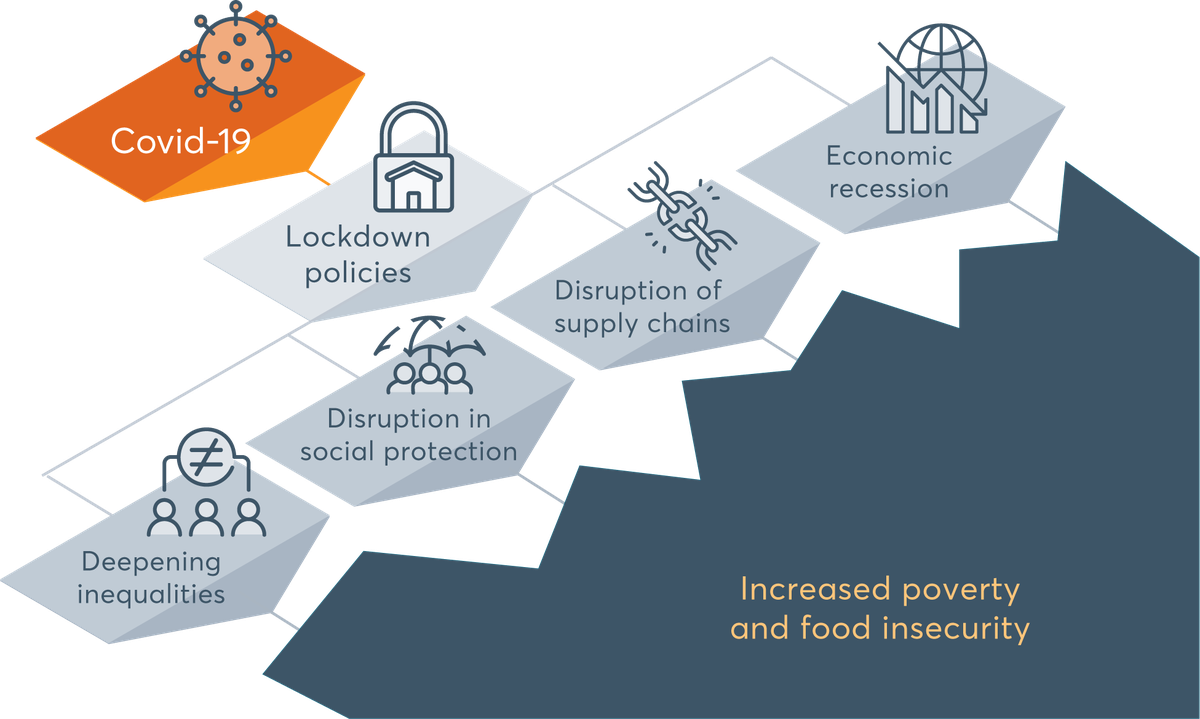
Pathways through which Covid-19 has influenced hunger and household food insecurity
Adapted from: High Level Panel of Experts on Food Security and Nutrition (HLPE). Impacts of COVID-19 on Food Security and Nutrition: Developing Effective Policy Responses to Address the Hunger and Malnutrition Pandemic. Rome, Italy: Food and Agriculture Organization of the United Nations, 2020.
Covid-19 lockdowns resulted in economic shocks at both macro- and micro-economic levels, disrupting food systems and food supply chains, causing loss of income and livelihoods, producing uneven trends in food prices, straining social safety nets and deepening existing inequity.[8][9] Although these impacts affected all countries, low-income countries faced more severe consequences. Closures of food service facilities, food shortages and price spikes were documented globally.[10] In Kenya, economic effects resulted in increased food insecurity,[11] while in Australia, food insecurity increased sevenfold among households experiencing considerable income losses. Food security has not returned to pre-Covid-19 levels in many countries, and as of 2024, an estimated 2.3 billion people worldwide were moderately or severely food insecure.[12]
Disruptions in international trade contributed to a global economic recession and a sharp decline in both national and household incomes. Border closures disrupted commodity trade, domestic transportation was affected and labour shortages emerged across food value chains. Remittances (money that families receive from abroad) fell by approximately 20%, further straining the financial stability of households dependent upon overseas income, compounding existing vulnerabilities, undermining food security and limiting access to nutritious foods in low- and middle-income countries.[13] Mobility restrictions, lockdowns and collateral damage to public health services produced the most significant global economic crisis in a century.[14]
A study in Zambia illustrates these dynamics at the household level. Within the country, where containment measures were implemented in March 2020, the share of household income spent on food purchases increased from 53.8% to 61.4% between 2015 and 2021, largely due to rising food prices.[15] In contrast, household dietary diversity improved in households that experienced income reductions: they showed a 1.5% higher probability of a diverse diet compared to households whose incomes were unaffected. This result likely reflected adaptive coping strategies, including reducing non-food expenditures, drawing on savings and purchasing less expensive, locally available foods. A gender-disaggregated analysis found that prior to the Covid-19 pandemic, female-headed households in Zambia were 2.7% less likely than male-headed households to experience severe food insecurity. This protective effect decreased to 2.3% during the crisis, consistent with broader evidence that female-headed households tend to allocate a higher share of income to food, healthcare and sanitation.[16]
Conflict and war are key drivers of food insecurity and persistent hunger.[17][18] Wars have become more prevalent, and chronic hunger and undernutrition has become increasingly concentrated in conflict-affected countries. Conflict affects nutrition through linked pathways: destruction of agricultural infrastructure, market disruption, displacement, loss of livelihoods, asset depletion, income loss and rising poverty.[19] At the same time, it weakens health systems through damage to facilities, shortages of medicines and supplies, displacement or targeting of health workers and interruption of vaccination and routine care. These effects can rapidly trigger acute food insecurity, but they can also persist for years or decades through long-term damage to livelihoods, child growth, service delivery and local market systems.
The mechanisms differ by conflict type. Under localised violence, some production and market functions may continue, and measures such as input support, cash transfers and protected supply corridors can still help stabilise access. Under prolonged civil war or state failure, these platform-based strategies often weaken or collapse because logistics, governance and service delivery systems deteriorate together. In blockade settings, food may remain physically present in the wider region but become politically inaccessible, making denial of access, rather than food availability alone, the central constraint. This pattern is visible across long-running conflicts in Africa, including Sudan, eastern Democratic Republic of the Congo, and parts of the Sahel, where repeated displacement, market disruption and service breakdown have turned acute shocks into protracted nutrition crises. In 2025, UN-linked reporting pointed to almost 25 million people at risk in Sudan, 28 million facing acute hunger in the Democratic Republic of the Congo and 52 million people expected to struggle to meet basic food and nutrition needs across West and Central Africa.[20]
Conflict can also have repercussions far beyond the immediate area of violence. The war in Ukraine caused substantial fluctuations in global staple grain prices, given Ukraine’s status as a leading grain exporter. Within two months of the conflict, wheat commodity prices increased by 20% to US$384 per tonne, exceeding the prior year’s level by more than 50%. In Egypt, where 80% of wheat comes from Ukraine and Russia, bread prices increased by 25%.[21] These price shocks reduced household purchasing power for nutritious foods while health systems in affected regions struggled with damaged infrastructure and supply disruptions. Similar patterns have emerged as the result of the war involving Iran. By mid-March 2026, the conflict had disrupted shipping and air routes, raised freight and fertiliser costs and threatened humanitarian cargo movements through the Strait of Hormuz, with the World Food Programme warning that the shock could push an additional 45 million people into acute hunger by June 2026. Wars such as those in Ukraine and Iran can generate food insecurity within months, and their nutritional consequences may last much longer through inflation, debt, disrupted healthcare and erosion of livelihoods.[22][23]
The conflict in Gaza illustrates how collapse in food access and collapse in health service delivery can reinforce each other. In July 2025, the World Health Organization director-general warned of mass starvation, while treatment centres for malnutrition were reported to be full and lacking sufficient emergency feeding supplies. In his speech, he noted how more than 20% of pregnant and breastfeeding women screened were found to be severely malnourished.[24] A July 2025 Integrated Food Security Phase Classification (IPC) alert warned that the food consumption threshold for famine had already been crossed in most areas of Gaza, with acute malnutrition rising rapidly.[25] Later, World Health Organization reporting indicated that 640,000 people were projected to face IPC Phase 5 (catastrophe) conditions by the end of September 2025. In such settings, effective interventions are well known and include emergency food assistance, therapeutic feeding, mobile health services and protection of humanitarian access.[26] However, the main constraint is less about the absence of technical interventions and more about the inability to deliver them at scale under conditions of restricted access, insecurity and political obstruction.
Environmental stressors, including climate change, soil erosion, water scarcity and biodiversity loss, pose significant and interlinked challenges to food systems. Climate influences agricultural productivity, and agricultural practices can degrade ecosystems and contribute to climate change. This climate–agriculture nexus in turn affects food and nutrition security. Climate-induced decreases in crop production, such as those caused by heat, drought or flooding, reduce farm-level income, with disproportionate impact on smallholder households, women and other vulnerable groups. These income losses also affect hired labour and can trigger broader economic instability. Reduced production leads to higher food prices, exacerbating access issues for vulnerable populations.
In Africa, agricultural productivity growth has declined by an estimated 34% since 1961, with climate change acting alongside soil degradation, under-investment, limited irrigation and lack of supportive policies.[27] Projections suggest that future warming will further shorten growing seasons and intensify water stress, threatening both livelihoods and nutritional outcomes.[28][29] In addition, climate change will affect food quality, with elevated atmospheric carbon dioxide possibly reducing zinc, iron and protein concentrations in some staple crops, creating nutritional risks even where calorie supply is maintained.[30]
Zoonotic diseases represent an additional, interconnected threat. Rural agricultural households are particularly exposed, and despite extensive international efforts towards control, zoonotic diseases continue to spread and re-emerge, driven by intensified global trade, environmental degradation and climate variability.[31]
Real-world strategies integrating health, food, nutrition and social protection to address polycrises
Polycrisis framing requires governments and partners to deploy integrated packages across health, nutrition, education, water and sanitation and social protection. Integrated packages can be activated rapidly and flexibly to safeguard nutrition for the most vulnerable populations when shocks disrupt food access, service delivery and incomes.
Country responses during Covid-19 demonstrate what integrated resilience looks like in practice.[32] Some governments (Indonesia and Sierra Leone) protected essential nutrition services by adapting delivery modalities rather than pausing programmes (Table 2.1). These adaptations allowed health system nutrition functions to continue even when facility-based services became inaccessible. Other countries, including the Bahamas, Brazil, India and Peru, kept child diets stable when schools closed by converting school meals into take-home rations, food vouchers, fortified staples or cash-based alternatives.
Many governments expanded social protection coverage and simplified access using digital applications and eligibility expansion to reach newly vulnerable groups, including migrants and people who had lost work, as in Colombia and South Africa. Some packages explicitly linked public health measures to nutrition protection, combining hygiene promotion and adapted water and sanitation services with expanded social protection for women, children and unemployed people. Governments also used economic measures to maintain food system functioning, such as providing low-interest loans and technical assistance for small- and medium-sized enterprises to sustain production and distribution in Ethiopia and Nigeria.
Table 2.1. Country resilience strategies during the Covid-19 pandemic
| Country | Description |
|---|---|
| Bahamas | Developed alternative school meal mechanisms, including monetary support or vouchers, to maintain child nutrition when schools closed. |
| Brazil | Converted school meals to take-home rations and expanded cash transfers, bridging food access gaps. |
| Colombia | Expanded eligibility of social protection to reach new and underserved populations; included migrants due to pandemic-related movement restrictions. |
| Ethiopia | Provided financial support including short-term, low-interest loans to small- and medium-sized enterprises to maintain food supply chains. |
| Ghana | Delivered iron/folate supplements through stationary and mobile systems; integrated nutrition education with health systems during school closures; integrated iron/folate into food ration distribution; increased the use of community-based channels for delivery. |
| India | Used multiple entry points to protect food and nutrition, including food, health, water and sanitation, education and social protection systems; adapted delivery of health services; changed school meals to take-home rations; expanded social protection programmes. |
| Indonesia | Switched to family-centred approaches for the detection of acute malnutrition by using community volunteers and mobile phones for care-giver training on screening children. |
| Liberia | Strengthened and leveraged local capacities to minimise disruptions in the delivery of essential services. |
| Nigeria | Provided financial support and technical assistance to small- and medium-sized enterprises. |
| Peru | Expanded the provision of fortified rice as part of school meals and in-kind food vouchers. |
| Philippines | Integrated hygiene kits into conditional cash transfer programmes, linking health protection with social assistance. |
|
Sierra Leone |
Switched the mode of delivery of vitamin A supplementation from mass campaigns to integration into routine healthcare at facilities; protected child health services and was able to sustain and scale up. |
|
South Africa |
Promoted hygiene; adapted water and sanitation systems; expanded social protection to women, children and unemployed people; digitised social protection enrolment, linking health system preparedness with food security. |
Three operational patterns emerge from these country experiences. First, countries responded flexibly by leveraging nutrition across the existing health and social protection delivery platforms of multiple systems through a variety of mechanisms, such as take-home rations, vouchers, fortified staples and cash. These actions maintained food access for the most vulnerable when normal channels were disrupted. Second, continuity of health system nutrition actions improved when delivery moved beyond facilities to communities: engagement of community workers, family-centred screening, mobile outreach and distribution bundled with rations. These approaches ensured that essential nutrition services remained accessible despite facility closures and mobility restrictions. Third, social protection reached additional at-risk groups when programmes changed access rules and processes, including temporary eligibility expansion, streamlined registration and digital application channels. For example, South Africa digitised social protection enrolment alongside hygiene promotion and adapted water and sanitation measures. Overall, country responses were diverse, context specific and often innovative - demonstrating the potential of flexible, multisectoral strategies to protect nutrition and build long-term resilience.
As noted by UNICEF, “No single system is likely to be sufficiently resilient on its own to fully mitigate the impact on food and nutrition security in the context of a poly crisis. This rich collection of country experiences demonstrates the importance of leveraging multiple systems – food, health, water and sanitation, education, and social protection systems – and enabling them to be more resilient in safeguarding access to nutritious diets, essential services, and supporting positive feeding and care practices during a poly crisis”.[33]
During the Covid-19 pandemic, countries with pre-existing infrastructure and flexible programmatic frameworks implemented actions more rapidly and effectively than those that needed to develop new approaches. Investing in integrated infrastructure and programmatic frameworks can therefore shorten response times and reduce nutrition impacts when shocks occur.
Country experiences demonstrate that resilience to shocks and stressors requires anticipatory integration of food system interventions with health system adaptations and social protection expansion (Box 2.3 and Box 2.4). When health crises disrupt food systems, maintaining nutrition outcomes depends on adapting health service delivery while simultaneously supporting food access. When food system shocks occur, health systems must be prepared to safeguard nutrition by detecting and treating increased malnutrition and delivering other essential nutrition services (such as school feeding, vitamin A supplementation, breastfeeding support and micronutrient supplementation) while food interventions restore access. This integrated approach represents a shift from parallel sectoral responses towards genuinely coordinated resilience strategies.
Ethiopia has consistently faced shocks and stressors, with famines occurring over decades and even centuries, the most recent in the early 1980s. Despite these catastrophic events, since the early 2000s, the country has made significant progress by establishing integrated policies that encompass social protection, agriculture, health and climate resilience.[34][35] The prevalence of undernourishment declined between 2000 and 2015, from more than 40% to less than 20%, although there has been an uptick to over 20% from 2015 to date. Similarly, stunting in preschool children declined from 1992 to 2020 as did the proportion of women aged 15–44 years who were classified as underweight.
Ethiopia has been resilient throughout repeated shocks using multisectoral strategies to address risks. The response to Covid-19 is an example of a multi-pronged resilience strategy. The health sector was effectively managed and modified through the implementation of a series of response measures. Specifically, the country established a national task force, launched public awareness campaigns, increased testing capacity and implemented travel restrictions and quarantine measures, while providing support to healthcare facilities and rolling out vaccination campaigns. It is interesting to note that in tandem with changes to the health system, Ethiopia’s Productive Safety Net Program (PSNP) provided needed support to address declining incomes, higher food prices and increased food insecurity. The PSNP includes a rural public works programme that provides direct support to labour-constrained households and for able-bodied adults with transient needs, an urban productive safety net programme that aims to improve the income of urban poor and a jobs support programme that aims to increase market inclusion of disadvantaged urban youth.[36]
The country has consistently emphasised a multisectoral approach to improving food security and nutrition since launching the Agricultural Growth Program to enhance agricultural productivity and market access in high-potential districts through improvement of practices and inputs, commercialisation and infrastructure development, and signing on to the Scaling up Nutrition Movement and being classified as an ‘early riser’ country at the launch of the movement in 2010.[37] Through these efforts, it has gained experience in integrating agriculture, health, education and social safety nets as a multidimensional strategy for achieving food security and nutrition. Currently, the Agricultural Growth Program emphasises climate-smart agriculture, including cultivating drought-resistant crops. In addition, the country’s National Nutrition Program has placed strong emphasis on multisectoral approaches and, importantly, established a governing structure to coordinate the efforts of nine ministries.[38] The government also launched the Ethiopian Food Systems Resilience Program, funded by the World Bank, and reaffirmed its commitment to transforming its food systems at the UN Food System Summit +4 Stocktake in 2025.[39]
The Ethiopian experience provides valuable lessons for future actions, and the country could build on this investment, but challenges persist. The percentage of the population experiencing moderate or severe food insecurity has remained high (around 55%), dietary diversity is low and more than 50% of the population cannot afford a healthy diet.[40] While multiple policies and programmes spanning agriculture, health and social safety are in place, these systems are stressed and beyond their ability to meet needs. There has been some criticism of the multisectoral approach, in part related to lack of policy implementation, fragmented efforts with weak coordination and lack of translation of research into action.[41] The country needs innovative government structures and an agri-food systems resilience approach, and to address any siloing that may cause bottlenecks to delivery through fragmented governance, incoherent policies and actions, uncoordinated financing and unmanaged competing priorities.[42]
In conclusion, while Ethiopia has substantial issues when it comes to food security and nutrition, the situation may have been worse without multiple policies and agriculture, health and social safety net programmes in place. However, these are extremely stressed, and the lack of adequate financing may be a critical barrier for widespread expansion of the programmes.
Box 2.4. Thailand’s experience in multisectoral actions linking food, nutrition and health
Thailand is classified as an upper-middle-income country by the World Bank.[43] The country’s economy advanced from an agricultural to an industrial one with the adoption of an industrial strategy in the late 1950s and the development of infrastructure.[44] This economic development coupled with a robust national nutrition strategy translated into the improved health and nutritional status of its population. The prevalence of undernourishment declined from 17.4% in the early 2000s to 5.6% in 2024.[45] This success can be attributed to Thailand’s multisectoral nutrition strategy, managed and implemented by the National Nutrition Committee (comprised of the health, education, agriculture and planning ministries) to ensure a multisectoral commitment to address malnutrition.[46] Further, Thailand invested in providing primary healthcare through a cadre of village health volunteers, 80% of whom were women. The volunteers were trained to provide primary care that included nutrition education to mothers and children.[47]
While there has been a substantial decline in wasting and stunting in children younger than 5 years, increases were observed from 2016 to 2024: stunting prevalence increased from 10.5% to 12.4% and wasting prevalence rose from 4.7% to 7.2%. In addition, one in ten children under 5 years experiences severe food poverty.[48] Similarly, exclusive breastfeeding rates are low (29%) and overweight and obesity are increasing, particularly in children (rising from 5.8% to 15% in 20 years).[49] Currently, volunteers support efforts to reduce child malnutrition, concurrently providing education on chronic disease prevention and management, both critical needs given the epidemiological trends.[50]
Like in many parts of the world, the Covid-19 pandemic worsened food security in Thailand, limiting access to diverse diets and nutritious foods. In 2020, 20 million people, particularly children and older adults, experienced undernourishment.[51] The Northeast region, the poorest and least developed, experienced the worst food insecurity; 60% of households ran out of food during the pandemic, in addition to losing jobs and sources of income.[52][53] In urban areas, people had limited access to nutritious food due to supply chain constraints and restrictions on the movement of goods, with young adults (15–29 years), low-income households and households/individuals with limited or no educational literacy most severely affected.[54]
The Thai government implemented several initiatives, including agricultural policies, introducing new loans for farmers, extending loan repayment periods and distributing aid to 10 million farmers for three months.[55] Food banks gained traction in Thailand, with more people accessing them to obtain food. Community-led grassroots efforts, such as the happiness-sharing pantries campaign, enabled food sharing, allowing people to donate items at select locations, where those in need could collect them.[56] Coupled with these food systems actions, village health volunteers became a significant asset, reaching people to run health campaigns and collecting timely data to track cases.[57]
Thailand is not immune to the negative consequences of rapid climate change, and its National Adaptation Plan lists potential risks to staples like rice and other grains from climate-induced disasters. It proposes adaptation strategies to mitigate adverse outcomes and shocks to the national food supply.[58] The resilience of Thailand’s food systems stems from prioritising nutrition and from a multifaceted approach that brings together all relevant entities to collaborate in implementing policies. Having a cadre of trained village volunteers that provides an established channel for promptly disseminating information, providing services and screening and collecting data, coupled with an adaptation strategy, is crucial for both mitigation and strengthening of the resilience of food systems.
Share Food systems resilience to shocks and stressors to support nutrition and health
Downloads
- English Executive Summary - 2026 Global Nutrition Report (PDF 1.1MB) Full Report - 2026 Global Nutrition Report (PDF 7.8MB)
- Spanish Executive Summary - 2026 Global Nutrition Report (Spanish) (PDF 1.3MB) Full Report - 2026 Global Nutrition Report (Spanish) (PDF 8.1MB)
- French Executive Summary - 2026 Global Nutrition Report (French) (PDF 1.1MB) Full Report - 2026 Global Nutrition Report (French) (PDF 7.9MB)
Executive Summary - 2026 Global Nutrition Report
Download a PDF of the executive summary of this year's report
Download the summaryFootnotes
-
Return to source text
Food and Agriculture Organization of the United Nations. Climate Smart Agriculture Sourcebook. Rome, Italy: Food and Agriculture Organization of the United Nations, 2013 https://openknowledge.fao.org/server/api/core/bitstreams/b21f2087-f398-4718-8461-b92afc82e617/content.
-
Return to source text
United Nations Children’s Fund, World Food Programme, Standing Together for Nutrition, Micronutrient Forum. Nutrition Resilience During Crises: Building on the lessons of the polycrisis to safeguard nutrition during future crises. Washington, DC: Micronutrient Forum, 2024. https://micronutrientforum.org/wp-content/uploads/2024/08/ST4N-GRR-brief_FINAL_22Aug2024.pdf.
-
Return to source text
Food Security Information Network, Global Network Against Food Crises. 2024 Global Report on Food Crisis: Joint Analysis for Better Decisions. Rome, Italy: Food Security Information Network & Global Network Against Food Crises, 2024. https://www.fsinplatform.org/grfc2024 (accessed Dec 11, 2025).
-
Return to source text
High Level Panel of Experts on Food Security and Nutrition. Building Resilient Food Systems. Rome, Italy: Food and Agriculture Organization of the United Nations, 2025. https://www.fao.org/media/docs/devhlpelibraries/report-20/hlpe-20-v0-draft_11-feb-2025-for-consultation.pdf?sfvrsn=80785bd7_3.
-
Return to source text
United Nations Office for Disaster Risk Reduction. The Sendai Framework Terminology on Disaster Risk Reduction. Definition: “Resilience.” 2017. https://www.undrr.org/terminology/resilience (accessed Feb 24, 2026).
-
Return to source text
Devereux S, Béné C, Hoddinott J. Conceptualising COVID-19’s impacts on household food security. Food Security 2020; 12: 769–72.
-
Return to source text
High Level Panel of Experts on Food Security and Nutrition. Impacts of COVID-19 on Food Security and Nutrition: Developing Effective Policy Responses to Address the Hunger and Malnutrition Pandemic. Rome, Italy: Food and Agriculture Organization of the United Nations, 2020. https://openknowledge.fao.org/server/api/core/bitstreams/8abcbe13-833e-4658-a339-4e3be593b66e/content.
-
Return to source text
Clapp J, Moseley WG. This food crisis is different: COVID-19 and the fragility of the neoliberal food security order. The Journal of Peasant Studies 2020; 47: 1393–417.
-
Return to source text
Klassen S, Murphy S. Equity as both a means and an end: lessons for resilient food systems from COVID-19. World Development 2020; 136: 105104.
-
Return to source text
Barrett CB. Actions now can curb food systems fallout from COVID-19. Nature Food 2020; 1: 319–20.
-
Return to source text
Onyango EO, Crush J, Owuor S. Preparing for COVID-19: household food insecurity and vulnerability to shocks in Nairobi, Kenya. PLOS ONE 2021; 16: e0259139.
-
Return to source text
Food and Agriculture Organization of the United Nations, United Nations Children’s Fund, World Food Programme, World Health Organization. The State of Food Security and Nutrition in the World 2025: Addressing high food price inflation for food security and nutrition. Rome, Italy: Food and Agriculture Organization of the United Nations, 2025. DOI:10.4060/cd6008en.
-
Return to source text
World Bank. World Bank Predicts Sharpest Decline of Remittances in Recent History. World Bank. 2020; published online April 22. https://www.worldbank.org/en/news/press-release/2020/04/22/world-bank-predictssharpest-decline-of-remittances-in-recent-history (accessed Feb 21, 2026).
-
Return to source text
World Bank. World Development Report 2022: Finance for an Equitable Recovery. Washington, DC: World Bank, 2022 https://www.worldbank.org/en/publication/wdr2022 (accessed Jan 6, 2026).
-
Return to source text
Bwalya R, Chama-Chiliba CM. COVID-19 lockdown and implications for household food security in Zambia: quality of diet or economic vulnerability? Economies 2025; 13: 200.
-
Return to source text
Kennedy E, Peters P. Household food security and child nutrition: the interaction of income and gender of household head. World Development 1992; 20: 1077–85.
-
Return to source text
Food and Agriculture Organization of the United Nations, International Fund for Agricultural Development, United Nations Children’s Fund, World Food Programme, World Health Organization. The State of Food Security and Nutrition in the World 2024: Financing to end hunger, food insecurity and malnutrition in all its forms. Rome, Italy: Food and Agriculture Organization of the United Nations, 2024. DOI:10.4060/cd1254en.
-
Return to source text
De Waal A. Armed conflict and the challenge of hunger: Is an end in sight? In: 2015 Global Hunger Index: Armed conflict and the challenge of hunger. Bonn, Germany; Washington, DC; Dublin, Ireland: Welthungerhilfe; International Food Policy Research Institute; Concern Worldwide, 2015: 22–9.
-
Return to source text
Jones G. Hunger crisis deepens in global hotspots as famine risk rises, UN warns. Reuters. 2025; published online June 16. https://www.reuters.com/business/healthcare-pharmaceuticals/hunger-crisis-deepens-globalhotspots-famine-risk-rises-un-warns-2025-06-16/ (accessed March 16, 2026).
-
Return to source text
Reuters. Record 28 million people face acute hunger in conflict-ravaged Congo. 2025; published online March 27. https://www.reuters.com/world/africa/record-28-million-people-face-acute-hunger-conflict-ravaged-congo-2025-03-27/?utm.com (accessed April 6, 2026).
-
Return to source text
Osendarp S, Verburg G, Bhutta ZA, et al. Act now before Ukraine war plunges millions into malnutrition. Nature 2022; 604: 620–4.
-
Return to source text
Angel M, Veyet T. How does the Iran war affect fertiliser supplies, prices and food security? Reuters. 2026; published online March 17. https://www.reuters.com/business/energy/how-does-iran-war-affect-fertilisersupplies-prices-food-security-2026-03-17/?utm (accessed April 6, 2026).
-
Return to source text
ANI News. WFP warns Middle East war could drive global hunger to record levels. 2025; published online March 18. https://www.aninews.in/news/world/europe/wfp-warns-middle-east-war-could-drive-global-hunger-torecord-levels20260318090537/ (accessed April 6, 2026).
-
Return to source text
Santhosh C, Rigby J, Rigby J. Gaza facing man-made ‘mass starvation’, says WHO’s Tedros. Reuters. 2025; published online July 24. https://www.reuters.com/business/healthcare-pharmaceuticals/gaza-facing-manmade-mass-starvation-says-whos-tedros-2025-07-23/ (accessed Feb 24, 2026).
-
Return to source text
Integrated Food Security Phase Classification. IPC ALERT: Worst-case scenario of Famine unfolding in the Gaza Strip. Rome, Italy: IPC Global Initiative, 2025. https://www.ipcinfo.org/fileadmin/user_upload/ipcinfo/docs/IPC_GazaStrip_Alert_July2025.pdf?utm.
-
Return to source text
Food Security Information Network, Global Network Against Food Crises. 2024 Global Report on Food Crisis: Joint Analysis for Better Decisions. Rome, Italy: Food Security Information Network & Global Network Against Food Crises, 2024. https://www.fsinplatform.org/grfc2024 (accessed Dec 11, 2025).
-
Return to source text
World Meteorological Organization. State of the Climate Update for COP30. Geneva, Switzerland: World Meteorological Organization, 2025. https://wmo.int/publication-series/state-of-climate-update-cop30 (accessed Feb 12, 2026).
-
Return to source text
High Level Panel of Experts on Food Security and Nutrition. Building Resilient Food Systems. Rome, Italy: Food and Agriculture Organization of the United Nations, 2025. https://www.fao.org/media/docs/devhlpelibraries/report-20/hlpe-20-v0-draft_11-feb-2025-for-consultation.pdf?sfvrsn=80785bd7_3.
-
Return to source text
Intergovernmental Panel on Climate Change. Climate Change and Land: IPCC Special Report on Climate Change, Desertification, Land Degradation, Sustainable Land Management, Food Security, and Greenhouse Gas Fluxes in Terrestrial Ecosystems. Cambridge, UK: Cambridge University Press, 2022. DOI:10.1017/9781009157988.
-
Return to source text
Medek DE, Myers SS. Estimated effects of future atmospheric CO2 concentrations on protein intake and the risk of protein deficiency by country and region. Environmental Health Perspectives 2017; 125: 087002.
-
Return to source text
High Level Panel of Experts on Food Security and Nutrition. Building Resilient Food Systems. Rome, Italy: Food and Agriculture Organization of the United Nations, 2025. https://www.fao.org/media/docs/devhlpelibraries/report-20/hlpe-20-v0-draft_11-feb-2025-for-consultation.pdf?sfvrsn=80785bd7_3.
-
Return to source text
United Nations Children’s Fund, World Food Programme, Standing Together for Nutrition, Micronutrient Forum. Nutrition Resilience During Crises: Building on the lessons of the polycrisis to safeguard nutrition during future crises. Washington, DC: Micronutrient Forum, 2024. https://micronutrientforum.org/wp-content/uploads/2024/08/ST4N-GRR-brief_FINAL_22Aug2024.pdf.
-
Return to source text
United Nations Children’s Fund, World Food Programme, Standing Together for Nutrition, Micronutrient Forum. Nutrition Resilience During Crises: Building on the lessons of the polycrisis to safeguard nutrition during future crises. Washington, DC: Micronutrient Forum, 2024. https://micronutrientforum.org/wp-content/uploads/2024/08/ST4N-GRR-brief_FINAL_22Aug2024.pdf.
-
Return to source text
Food and Agriculture Organization of the United Nations. Nutrition-Sensitive Agriculture in Ethiopia: Country Case Study. Rome, Italy: Food and Agriculture Organization of the United Nations, 2021.
-
Return to source text
United Nations Children’s Fund. Ethiopia Country Programme Overview. New York, NY: United Nations Children’s Fund, 2023. https://www.unicef.org/ethiopia/reports/country-programme-overview (accessed April 4, 2026).
-
Return to source text
World Bank. Project Information Document (Appraisal Stage): ET Productive Safety Nets 4 Program (PSNP 4) - P146883. Washington, DC: World Bank, 2014. https://documents.worldbank.org/en/publication/documents-reports/documentdetail/777941468180270058/ethiopia-productive-safety-net-project-4 (accessed Nov 28, 2025).
-
Return to source text
Food and Agriculture Organization of the United Nations. The Agricultural Growth Project (AGP). 2020. https://www.fao.org/in-action/epic/resources/ex-act-case-studies/ethiopia/fr/ (accessed April 14, 2026).
-
Return to source text
Maru Y, Chitekwe S, Mesfin F, et al. Multisectoral approach to nutrition in Ethiopia assessed through the lens of the collective impact framework: a qualitative study. Maternal & Child Nutrition 2025; n/a: e70091.
-
Return to source text
Global Center on Adaptation. Food Security Resilience Project in Ethiopia. 2023. https://gca.org/gca-project/wbg-food-security-resilience-project-in-ethiopia/ (accessed Feb 21, 2026).
-
Return to source text
Food and Agriculture Organization of the United Nations, United Nations Children’s Fund, World Food Programme, World Health Organization. The State of Food Security and Nutrition in the World 2025: Addressing high food price inflation for food security and nutrition. Rome, Italy: Food and Agriculture Organization of the United Nations, 2025. DOI:10.4060/cd6008en.
-
Return to source text
Zerfu T. Heavy on plans, light on delivery: the structural failures of Ethiopia’s nutrition policies. Maternal & Child Nutrition 2025; 21: e70073.
-
Return to source text
Food and Agriculture Organization of the United Nations, United Nations Children’s Fund, World Food Programme, World Health Organization. The State of Food Security and Nutrition in the World 2025: Addressing high food price inflation for food security and nutrition. Rome, Italy: Food and Agriculture Organization of the United Nations, 2025. DOI:10.4060/cd6008en.
-
Return to source text
World Bank. Thailand Now an Upper Middle Economy. World Bank. 2011; published online Aug 2. https://www.worldbank.org/en/news/press-release/2011/08/02/thailand-now-upper-middle-income-economy (accessed Feb 21, 2026).
-
Return to source text
Robinson D, Teja RS, Byeon Y, Tseng WS. Thailand: Adjusting to Success: Current Policy Issues. Washington, DC: International Monetary Fund, 1991 DOI:10.5089/9781557752215.084.
-
Return to source text
Concern Worldwide & Welthungerhilfe. Global Hunger Index: Thailand. Global Hunger Index. 2025. https://www.globalhungerindex.org/thailand.html (accessed April 15, 2026).
-
Return to source text
Gillespie S, Tontisirin K, Zseleczky L. Local to national: Thailand’s integrated nutrition program. In: Nourishing Millions: Stories of Change in Nutrition. Washington, DC: International Food Policy Research Institute, 2016: 91–8.
-
Return to source text
Kowitt SD, Emmerling D, Fisher EB, Tanasugarn C. Community health workers as agents of health promotion: analyzing Thailand’s village health volunteer program. Journal of Community Health 2015; 40: 780–8.
-
Return to source text
United Nations Children’s Fund. 1 in 10 children in Thailand live in severe child food poverty – UNICEF. 2024; published online June 6. https://www.unicef.org/thailand/press-releases/1-10-children-thailand-live-severechild-food-poverty-unicef (accessed Oct 23, 2025).
-
Return to source text
World Health Organization. Thailand’s Leadership in the Fight Against Obesity: Changing the System for Healthier Lives. WHO Feature Stories. 2025; published online March 7. https://www.who.int/thailand/news/feature-stories/detail/thailand-s-leadership-in-the-fight-against-obesity (accessed Feb 21, 2026).
-
Return to source text
Kowitt SD, Emmerling D, Fisher EB, Tanasugarn C. Community health workers as agents of health promotion: analyzing Thailand’s village health volunteer program. Journal of Community Health 2015; 40: 780–8.
-
Return to source text
Pechdin W, Bunditsakulchai P. Characteristics of individuals at risk of malnutrition in Thailand: an investigation focusing on income insecurity. Frontiers in Sustainable Food Systems 2024; 7.
-
Return to source text
Phulkerd S, Thongcharoenchupong N, Chamratrithirong A, et al. Socio-demographic and geographic disparities of population-level food insecurity during the COVID-19 pandemic in Thailand. Frontiers in Public Health 2023; 10.
-
Return to source text
World Bank. Impact of COVID-19 on Thailand’s Households. 2021. https://www.worldbank.org/en/country/thailand/publication/monitoring-the-impact-of-covid-19-in-thailand (accessed Feb 21, 2026).
-
Return to source text
Phulkerd S, Thongcharoenchupong N, Chamratrithirong A, et al. Socio-demographic and geographic disparities of population-level food insecurity during the COVID-19 pandemic in Thailand. Frontiers in Public Health 2023; 10.
-
Return to source text
Agroberichten Buitenland. Update on COVID-19 impact in Thailand. 2020; published online April 28. https://www.agroberichtenbuitenland.nl/actueel/nieuws/2020/04/28/update-on-covid-19-impact-in-thailand (accessed Feb 21, 2026).
-
Return to source text
Chatinakrob T. Happiness-sharing pantries and the ‘easing of hunger for the needy’ in Thailand. In: COVID-19 in Southeast Asia: Insights for a Post-pandemic World. London, UK: LSE Press, 2022: 249–56.
-
Return to source text
Narkvichien M. Thailand’s 1 million village health volunteers – “unsung heroes” – are helping guard communities nationwide from COVID-19. World Health Organization. 2020; published online Aug 28. https://www.who.int/thailand/news/feature-stories/detail/thailands-1-million-village-health-volunteers-unsung-heroes-are-helpingguard-communities-nationwide-from-covid-19 (accessed Feb 21, 2026).
-
Return to source text
Department of Climate Change and Environment. Thailand’s National Adaptation Plan (NAP) 2024. Bangkok, Thailand: United Nations Framework Convention on Climate Change, 2024 https://unfccc.int/sites/default/files/resource/NAP_THAILAND_2024.pdf.