Executive summary



The 2026 Global Nutrition Report (GNR) addresses one of the defining challenges of our time: how to achieve healthy diets for all as climate change undermines food and health systems simultaneously. Globally, 2.6 billion people cannot afford a healthy diet, with the burden concentrated in low- and middle-income countries.[1] Progress towards the global nutrition targets and Sustainable Development Goals 2 (zero hunger) and 3 (good health and well-being) remains off track. Undernutrition persists in many settings, while overweight, obesity and diet-related non-communicable diseases are on the rise.
These pressures are intensifying. Long-term climate shifts and more frequent extreme weather events lower agricultural productivity, reduce the nutritional value of some staple crops, raise food prices, damage health and sanitation infrastructure and increase climate-sensitive disease burdens. These effects disrupt food value chains and health services at the same time, compounding the impacts of conflict, economic crises and pandemics. Together, they risk reversing past nutrition gains.
The Nutrition for Growth (N4G) Paris 2025 Summit, hosted by the government of France, emphasised the urgency of integrated action across health, food systems, social protection, resilience and nutrition governance at a time when the multilateral and financing environment has weakened significantly. Recent reductions in official development assistance, including major bilateral cuts, are projected to deprive 2.3 million children of treatment for severe acute malnutrition and contribute to an estimated 369,000 additional child deaths annually.[2] Nutrition also remains critically under-prioritised in climate finance. Only 2% of countries’ national climate pledges and 16% of national climate adaptation plans include explicit resource mobilisation for nutrition, and the share of public climate financing directed to food systems declined between 2017 and 2022.[3] Within this context, integrating action across the food, health and climate sectors while embedding social protection across these domains, is not simply an ambitious goal but a fiscal and strategic necessity.
Against this backdrop, the objectives of the 2026 GNR are to:
- Examine how food and health systems build resilience to compounding shocks, drawing on country-level evidence.
- Review food systems strategies that support both human and planetary health while assessing their synergies and trade-offs.
- Analyse the role of gender across food and health system actions.
- Examine how governance and financing shape the capacity of these systems to deliver healthy diets.
- Assess the commitments made at the N4G Tokyo 2021 and Paris 2025 Summits, with attention to integration of food and health, gender and accountability.
The GNR’s Independent Expert Group led an interdisciplinary team of prominent researchers to develop the findings and recommendations in this report. Drawing on five commissioned thematic background research papers and an analysis of commitments registered in the GNR Nutrition Accountability Framework, the report argues that the convergence of these challenges presents an opportunity. By being more intentional and explicit about the synergies and trade-offs that exist when operating across food, health and climate systems, which have until now often been acknowledged only implicitly, policymakers and programme implementers can drive more effective and accountable action.
Key findings: Evidence on integration, resilience, trade-offs and accountability gaps
Four key findings from the evidence and analysis shape the report’s conclusions and recommendations:
- Continued focus on coordinated and integrated action is needed to protect nutrition under polycrisis conditions. Protecting nutrition under compounding shocks depends on coordinated and integrated action across food and health systems, including social protection and water and sanitation services on which health outcomes depend. Crises increasingly occur in tandem, creating a situation of ‘polycrises’, whereby one crisis intensifies another in ways that produce effects more severe than the sum of individual shocks. These polycrises require responses that go beyond single-sector measures. A review of country experiences during the Covid-19 pandemic, conflict and climate-related emergencies showed that countries with pre-existing integrated infrastructure and flexible programmatic frameworks responded more rapidly and effectively than those that needed to build new approaches under pressure. Three patterns stood out: 1) food and nutrition support scaled fastest when delivered through existing platforms such as school feeding and cash transfer programmes; 2) health system nutrition services were sustained when delivery shifted to community-based and mobile channels; and 3) social protection reached newly vulnerable groups when eligibility rules and registration processes were adapted quickly. Investing in integrated infrastructure, prior to shocks occurring, is critical to shortening response times and reducing nutrition impacts.
- Promising food systems strategies can support nutrition, but understanding trade-offs is crucial. The report identifies three promising food systems strategies to support nutrition within climate change: climate-smart agriculture, actions shaping food environments to support sustainable healthy diets and reducing food loss and waste. Important synergies exist across these areas, but trade-offs also arise and must be addressed explicitly. For example, dietary guidance encouraging a shift towards plant-based diets can generate major co-benefits, including lower premature mortality and reduced food systems emissions. However, such shifts could increase risks of micronutrient deficiencies for specific vulnerable groups if not accompanied by complementary health system action, including dietary counselling, supplementation and fortification. They may also affect livelihoods in communities dependent upon animal-source food production. A caveat of the research literature recommending plant-based dietary shifts is the reliance on adult chronic disease outcomes, often drawn from high-income populations, which introduces a bias given differing health risks, diets and life expectancies across different contexts. Despite the increasing prevalence of non-communicable diseases globally, an exclusive focus on this evidence base may appear to overlook the immediate priorities in low- and middle-income countries, including the reduction of stunting, wasting, anaemia and low birth weight that are central to the World Health Assembly’s global nutrition targets. Future research needs to examine or incorporate diverse health outcomes and context-specific evidence. Programmatically, alternative strategies to support sustainable animal-source foods and/or animal-source food alternatives will need to be considered, particularly for specific population subgroups to achieve their nutrient requirements. Reducing food loss and waste raises a different set of trade-offs. It can improve food availability and lower emissions, but energy-intensive storage solutions risk offsetting mitigation gains. However, these trade-offs are not reasons to avoid action. They are reasons to design interventions with full awareness of their consequences across systems. In practice, for dietary transitions, this means pairing dietary transition strategies with health system measures that protect micronutrient adequacy for vulnerable groups. For food loss reduction, it requires coupling investments with low-emissions storage technologies rather than energy-intensive alternatives.
- Food and health system integration remains inconsistent and requires intentionality. At the policy and implementation level, the report notes that food system and health system integration is taking place in some areas, but unevenly and without consistent design and intentionality. Analysis showed that more than two-thirds of the commitments from the N4G Tokyo 2021 Summit and half of the commitments from the Paris 2025 Summit focused on food systems challenges and were UN Food Systems Summit–linked commitments. Across both N4G summits, around 750 commitments included both food and health system actions, indicating a degree of cross-sector engagement. However, the analysis also identified clear weaknesses. Around one-quarter of food systems commitments could not be meaningfully categorised, which points to problems of specification and design. Gender integration remained shallow across the global commitment architecture. Of 631 Paris Summit commitments analysed, 70% showed no connection to gender. Only 2% were classified as gender transformative. Even among commitments related to agri-food systems and climate, two-thirds lacked any gender dimension. This is despite strong evidence that women’s access to resources, services and decision-making power is associated with better food security and nutrition outcomes, including during crises. Climate change amplifies these inequities by increasing women’s unpaid care burdens, reducing incomes and disrupting access to health and nutrition services. Without deeper gender integration, commitments risk reinforcing the very inequalities they aim to address, and nutrition strategies will underperform precisely where needs are greatest.
- Analysis revealed a need for substantive accountability when making future commitments. Analysis of N4G commitments showed a widening gap between procedural and substantive accountability. On the procedural side, progress is clear: more than half of government commitments at the N4G Paris Summit achieved high or upper-moderate SMART (Specific, Measurable, Achievable, Relevant and Time-bound) scores. However, substantive accountability, meaning the extent to which commitments are embedded within financing, institutional and resilience frameworks, has not kept pace. Few commitments included secured financing, and only 8% used monitoring indicators aligned with specific food systems frameworks. Resilience considerations were largely absent from commitments focused on a single system, yet presented in nearly three-quarters of those that explicitly linked food and health systems. This suggests that integration needs to go beyond a policy aspiration to be used as a practical lever or effectively implemented in practice. When commitments are designed across food and health systems, the questions they must address, including financing, resilience and equity, become harder to leave implicit.
Taken together, these findings point to a recurring problem. While awareness of the interconnections between food systems, health systems and climate is now widespread, commitments continue to be designed, financed and monitored with single-sector logic.[4][5] A more fundamental issue lies beneath these structural constraints. There is often a limited understanding of what is gained and what is lost when one policy option is prioritised over another. What is needed is a more deliberate consideration of these trade-offs, recognising that every policy choice entails costs as well as benefits and that these choices are shaped by competing interests, incentives and institutional priorities. Embedding both awareness and intentionality within the policy process would shift decision-making from being merely procedural towards becoming genuinely substantive.
To support this shift, the report presents an analytical framework for achieving healthy diets through integrated food and health system action within climate change (See Figure). The framework builds on existing literature and traces how food and health systems interact through supply-side and demand-side pathways, identifying critical integration points. It highlights four enabling functions, namely 1) leadership and governance, 2) financing, 3) operational capacity, and 4) research and monitoring, that determine whether integrated action can be delivered and sustained. It orients action towards three interconnected outcomes: environmental soundness and resilience, social equity and gender empowerment and economic prosperity.
The framework does not seek to replace existing food system or health system frameworks. Rather, it bridges them by making explicit where actions in one system depend on responses in the other, what enabling conditions are required and where trade-offs must be managed. While many existing frameworks identify interconnections, this framework goes beyond that to identify the specific points at which deliberate choices between systems must be made. Its purpose is to provide policymakers, commitment makers and researchers with a practical structure for designing coherent strategies and commitments that are both viable and accountable. It is also intended as a tool for commitment makers preparing for future N4G Summits, helping to move future pledges beyond procedural specification towards substantive accountability by requiring explicit attention to financing, delivery capacity and the trade-offs that need to be navigated.
Figure. Achieving healthy diets for all through food and health system transformation within a changing climate
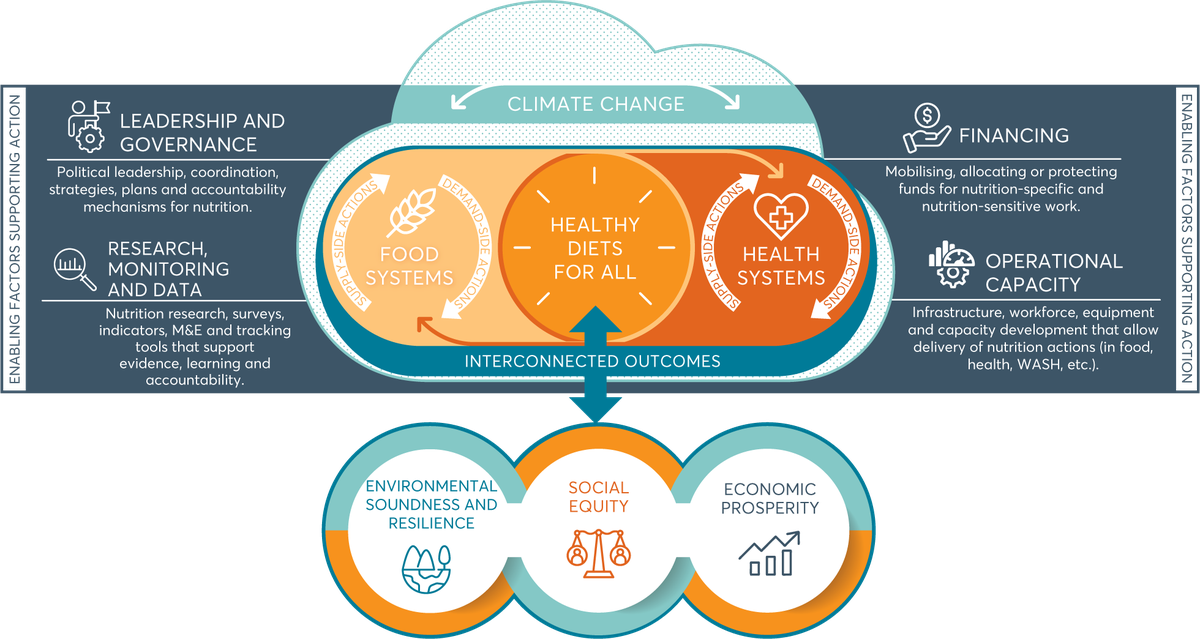
Achieving healthy diets for all through food and health system transformation within a changing climate
Abbreviations: M&E, monitoring and evaluation; WASH, water, sanitation and hygiene.
Several of the report’s recommendations reinforce the priorities identified and ratified by both the N4G Tokyo and Paris Summits. The report’s contribution to the Summit-ratified priorities is to identify why progress has been limited and what is needed to overcome the structural barriers that persist: institutional fragmentation, short-term financing architectures and weak alignment between global commitments and national implementation instruments. Other recommendations - on the integration of food–health actions as a resilience condition, the shift from procedural to substantive accountability and the shallow framing of gender - reflect priorities that emerge specifically from this report’s analysis.
The report’s recommendations are offered as considerations informed by the evidence reviewed, rather than as a universal prescription. Many governments and partners may already be pursuing some or all of these directions, and the relevance and sequencing of specific actions will depend on national and subnational contexts, including existing policy frameworks, institutional capacity and financial conditions. Where action is already underway, the recommendations may help identify areas for deepening integration or strengthening accountability.
- Governments are encouraged to integrate nutrition into existing primary healthcare and social protection platforms, and to embed nutrition targets within national climate strategies to unlock climate finance and strengthen governance to deal with cross-sector challenges.
- Donors, development banks and climate finance providers should shift towards multi-year, flexible financing that supports integrated food–health delivery and maintains services during shock, and invest in domestic financing systems so that implementation is not wholly dependent upon external aid.
- Global platforms, UN agencies and accountability bodies should evolve accountability from procedural compliance to substantive integration, assessing whether commitments are backed by secured financing, cross-sector coordination and adequate delivery capacity.
- Civil society, women’s organisations and frontline providers should be supported in securing formal roles in governance and planning processes. Linking community platforms to both food and health systems could reveal context-specific and emerging challenges, revealing real-time implementation gaps and further supporting service uptake.
- The private sector should improve the availability, affordability and desirability of nutritious foods, guided by transparent nutrition and emissions disclosures and clear accountability standards, in line with the guiding principles agreed at the N4G Paris Summit.
The report recognises these recommendations must be pursued under real constraints, including fiscal pressure, political competition and institutional fragmentation.[6][7][8] Implementation will require prioritisation, sequencing and difficult choices. Within the context of constrained fiscal space, including the projected 9% reduction in official development assistance in 2025 and simultaneous cuts by the four largest donors, transformation must centre on strengthening domestic institutions and reallocating existing resources rather than expanding external aid. The highest co-benefit entry points at the lowest political cost are integrating nutrition into existing primary healthcare platforms and social protection systems and redirecting a share of the approximately US$540 billion in annual agricultural subsidies towards nutrient-dense foods. Embedding nutrition commitments within medium-term expenditure frameworks and national climate strategies increases their political durability and reduces the risk of discretionary cuts. Opportunity for action is high: for every dollar invested in addressing undernutrition, a return of US$23 is expected.[9] Withdrawing preventive and nutrition-sensitive programmes may ease budgets in the short term but will compound long-term expenditure on healthcare and lost productivity. The Food and Health Systems for Equitable Nutrition (FHEN) Framework presented in the 2026 GNR is intended to help navigate these choices, making trade-offs visible so that action can be intentional and explicit, identifying cross-sector synergies and ensuring that the costs of policy decisions do not fall disproportionately on those already most at risk. In a period of shrinking resources and intensifying climate pressure, this deliberate approach is key to protecting nutrition gains. Among the policy levers available, one stands out for its potential to anchor this integration: positioning nutrition as a core function of universal health coverage and primary healthcare, embedding life-course nutrition actions within the delivery platform that reaches the greatest number of people, particularly women and children in low- and middle-income countries, and creating a durable institutional home for nutrition within health systems that is less vulnerable to funding cuts. Achieving healthy diets for all will require action well beyond the health sector, across food systems, social protection, climate policy and governance. But a health system that treats nutrition as central to its mandate can serve as both a foundation and an accelerator for this broader transformation.
Share Executive summary
Downloads
Executive Summary - 2026 Global Nutrition Report
Download a PDF of the executive summary of this year's report
Download the summaryFootnotes
-
Return to source text
Food and Agriculture Organization of the United Nations, United Nations Children’s Fund, World Food Programme, World Health Organization. The State of Food Security and Nutrition in the World 2025: Addressing high food price inflation for food security and nutrition. Rome, Italy: Food and Agriculture Organization of the United Nations (FAO), 2025 DOI:10.4060/cd6008en.
-
Return to source text
Andridge C, McCarter A, D’Alimonte M, Nyaku A. Tracking aid for the WHA nutrition targets: Progress toward the global nutrition goals between 2015 to 2022. Washington, DC: Results for Development, 2024. https://r4d.org/resources/tracking-aid-wha-nutrition-targetsglobal-spending-roadmap-better-data/ (accessed April 6, 2026).
-
Return to source text
Initiative on Climate Action and Nutrition. Advancing Synergies Across Nutrition and Climate Action: I-CAN Assessment 2025. Geneva, Switzerland: Global Alliance for Improved Nutrition, 2025. https://www.gainhealth.org/sites/default/files/publications/i-canassessment-2025.pdf.
-
Return to source text
Béné C. Resilience of local food systems and links to food security – A review of some important concepts in the context of COVID-19 and other shocks. Food Security 2020; 12: 805–22.
-
Return to source text
Ericksen PJ. Conceptualizing food systems for global environmental change research. Global Environmental Change 2008; 18: 234–45.
-
Return to source text
Caleffi S, Hawkes C, Walton S. 45 actions to orient food systems towards environmental sustainability: Co-benefits and trade-offs. London, UK: Centre for Food Policy, 2023. https://www.foodsystemsdashboard.org/resources/45-actions-to-orient-food-systemstowards-environmental-sustainability-co-benefits-and-trade-offs.pdf.
-
Return to source text
International Panel of Experts on Sustainable Food Systems & ETC Group. A Long Food Movement: Transforming Food Systems by 2045. Brussels, Belgium: International Panel of Experts on Sustainable Food Systems, 2021. https://www.ipes-food.org/_img/upload/files/LongFoodMovementEN.pdf.
-
Return to source text
Moallemi EA, Miller M, Szetey K, et al. Entry points for driving systemic change toward a more sustainable future. One Earth 2025; 8.
-
Return to source text
Shekar M, Shibata Okamura K, Vilar-Compte M, Dell’Aira C. Investment Framework for Nutrition 2024: Human Development Perspectives Overview Booklet. Washington, DC: World Bank, 2024. DOI:10.1596/42164.